Category Archives: Cycling

The Ride to See 2015

Today’s ride: The Ride to See is a charity event that benefits vision research and programs for the blind. The rides start from Galena Maryland on the Eastern Shore, and goes through towns like Rock Hall and Chestertown.  The ride is held on the second saturday in August. This can be a hot ride, so hydration is important. The Ride to See rolls through farmland, past the Chesapeake bay, by creeks and rivers, and it also coincides with a festival in Rock Hall.  Rides range from 15 miles to a full century. The shorter rides can be good training rides for longer rides later in the year.

The Experience: This year it was a smaller crew riding the Ride to See, just Ron, Rita and Myself.  I set out feeling good, so I led most of the way to the first rest stop. The day was still cool, and while this wasn’t the best way to go, it felt like a great day to ride. The second leg to Rock Hall was relatively fast. When we reached the rest stop, the “Pirates and Wenches” festival was lively, and we rolled past the beach and into the rest stop with pirates all around us. I was starting to feel the heat, and made the most of the stop, but by the time I got to Chestertown, I was beginning to feel the heat, and all the pulling I did early in the ride was beginning to tell. I began to suffer in the hills between Chestertown and the final rest stop.  A quick stop for a gel helped, and I managed to hold onto the team as we reached the final stop. After a good rest and more water, I found a way to finish the ride strong. We managed to find more friends to celebrate with at the crab deck afterward – and the celebration made the difficulty of the ride worthwhile.

Selections from my mental iPod during the ride: “Houses of the Holy” by Led Zeppelin, and “Lost in the Supermarket” by the Clash. 

Stats: 100 Miles ridden, and despite pushing too hard in the first half of the ride, I managed to finish the ride without incident.    


IMG_0274

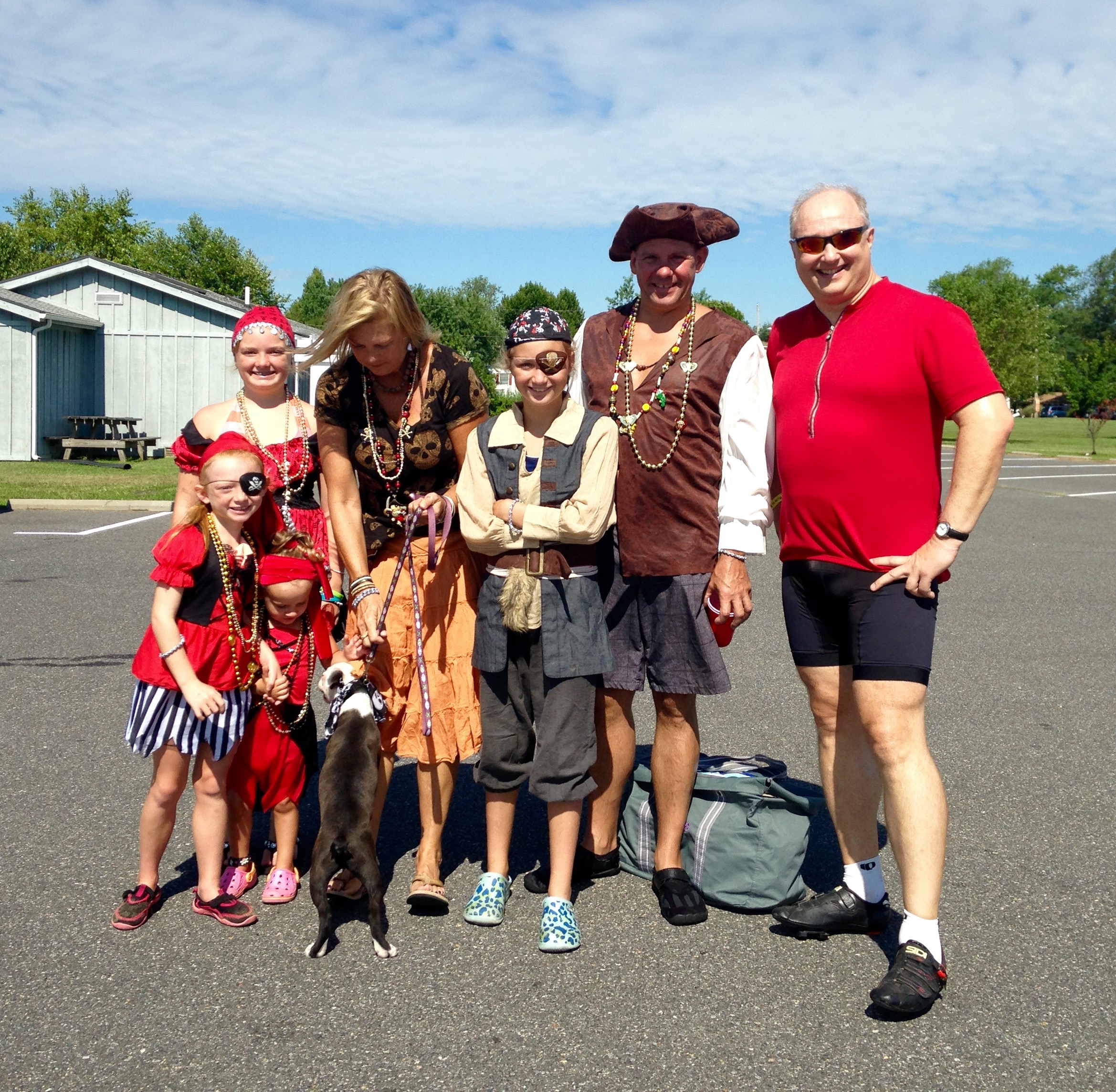
Hanging out with Pirates in Rock Hall


IMG_0277

Tom Roman, Ron, Theresa, Rita and I celebrate a memorable day.

Delaware Double Cross 2015

Today’s ride: The Delaware Double Cross is a Metric (62 miles) put on by the White Clay Bicycle Club, and it crosses the narrow portions of the state of Delaware twice. Since it’s held in the first weekend in July, it has the tendency to be HOT. Hydration is key for any hot ride, but the Double Cross is well supported over the distance. The ride is mostly flat, but there is often wind to contend with.

The Experience: My ride started with an email from my friend Ron – my usual partner in crime, who keeps careful track of rides within driving distance of Washington DC, asking if I was up for riding the Double-cross again. I’m not hard to convince to take a ride, and of course I agreed.  Though we typically have several riders at events, this time it was just the two of us on the roads across Delaware. We found ourselves heading out on a calm day that wasn’t too hot, so we had good conditions. We rolled through Middletown to cross route 13, where a number of riders were waiting to cross.  Ron immediately jumped when the light changed and set a hard pace. He was trying to get past a group of slower riders, but riding fast is often a challenge to other riders, and while we did manage to leave the riders we wanted to leave, there were some strong riders behind us that kept up.  This included several women who had similar kit and had the look of racers. With the sound of others behind us, Ron kept up the pace.  By the time he let up on the gas, we had dropped all but the strongest riders behind us.  We let them pass and I took over the pacemaking to the first rest stop in Port Penn. I watched a rider take up with the group I thought of as “the racers”, but he didn’t last. When we passed him, he had dropped off and picked up the wheels of another group.

There are riders who come to events who do this – pick up wheel after wheel to ride in a draft, perhaps feeling like a racer, but contributing nothing to the others in the group.  If they’re in the middle of a line, they can split your line or even crash, because they are usually going faster than they’re accustomed to riding.  If they’re hanging on to the back, they’re taking a risk to themselves, but otherwise, they can be a real risk to a group if they are in the middle. In some events, such riders may form ad-hoc groups, but normally such riders are shy about pulling a group behind them. They’re known to most cyclists by the term “wheel sucker”.

Riders like this aren’t intentionally dangerous.  They just don’t understand the problems they’re creating.  As the ride progressed, Ron and I overtook another group whom we passed on a climb.  On the downhill, they sprinted past, cut right in front of us, and slowed down!  Did they intend to ride dangerously?  No. They were having fun.  They didn’t realize how dangerous they were being.  We lifted our pace and dropped those riders.  Later, we were caught by another group, but when the road began to rise, I held my pace, and Ron and I rode away from that group. They had nobody to pull them up to us – they were followers, not leaders. Riders of the kind we met that day are wild cards. You don’t know if they’ll be trouble. Sometimes the best way to deal with trouble is to avoid it. Taking random wheels at an event is not the way to learn to draft.

For most of the day, we rode well, and since the day wasn’t too hot, we covered the course at a good pace. In the end, we came in strong, and earned our post-ride celebration!

Selections from my mental iPod during the ride: “Why Can’t I Be You?” – The Cure, “Love, Reign O’er Me” – The Who.

Statistics: 65.41 Miles at a strong consistent pace from the start to the finish.  This felt good for two riders cooperating over that distance.

IMG_0266

At the rest stop halfway through. This was after the first loop, at the same place where we started and finshed.

IMG_0268

This Steel Lighthouse was one of the interesting sights on the second loop.

IMG_0269

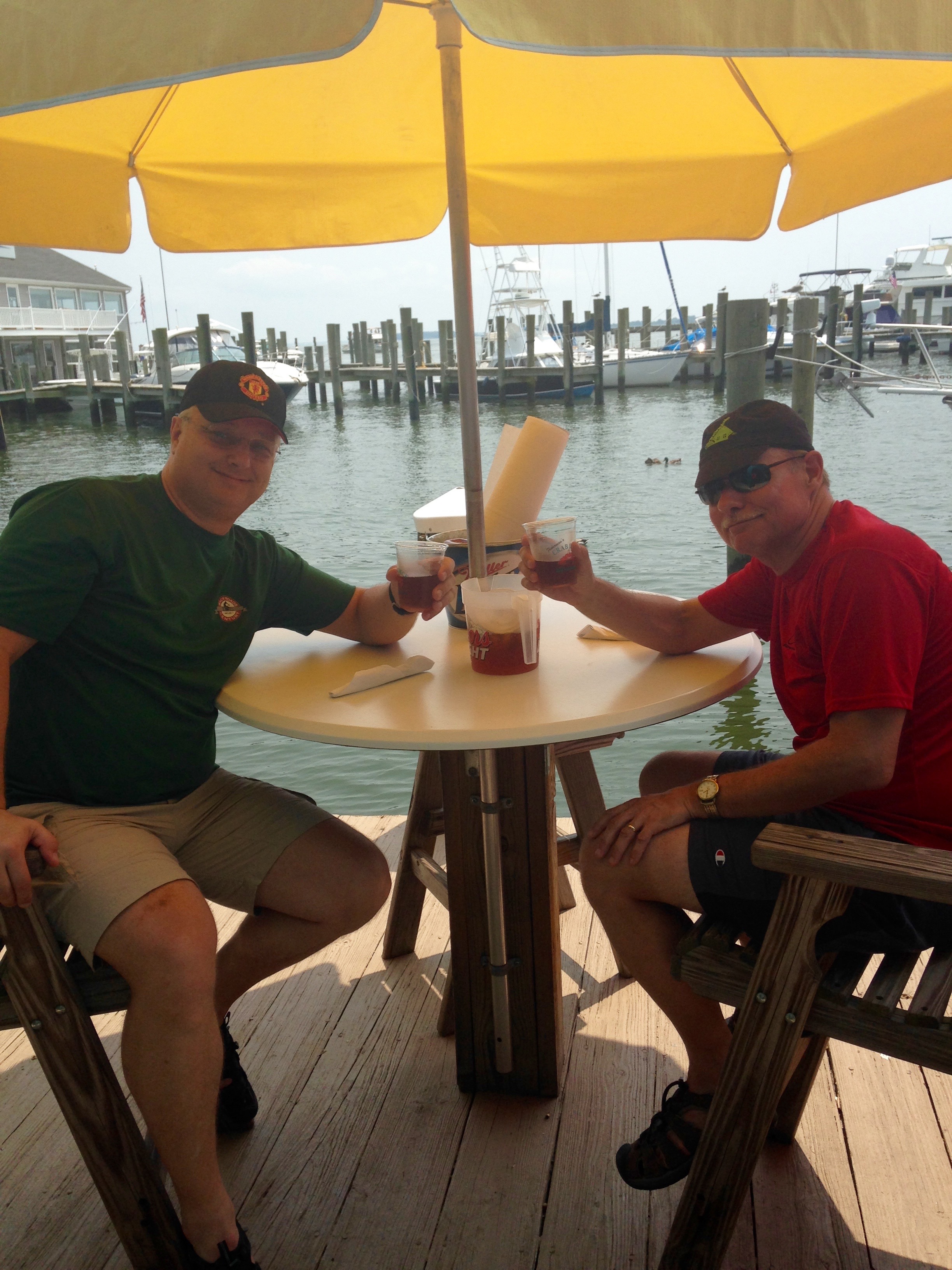
Celebrating after the ride on the Crab Deck at Kent Narrows.

Storming of Thunder Ridge 2015

Today’s ride: Storming of Thunder Ridge (SOTR) is a ride onto the Blue Ridge Parkway from Lynchburg VA.  This is a very challenging ride, the highlight of which is a 13 mile climb and a long descent, including a winding technical descent that is a challenge to any rider. Of all the rides I’ve done, I count this one among the most difficult. A 13 mile climb is a challenge for the body and mind alike. This is a ride for climbers. If you want to ride  SOTR, spend a couple of months training in the hills. Be prepared for a challenge. You will suffer. This can be a good thing.  However, a rider is rewarded by awe inspiring scenery on this ride. This is a ride to be proud of finishing! One thing this ride gives you is good mementos: this year we received a pint glass in addition to the usual shirt and optional jersey, which were excellent designs. There were snacks,  a vitamin sample, a tote bag, and even a sample of chain lubricant. Nobody goes home from SOTR empty handed!

The Experience: My ride up Thunder Ridge started with an innocent email from my friend Ron, who said “What do you think of this one?” with a link to SOTR.  Being a good friend and generally more enthusiastic than analytic, I agreed to sign up.  I was told that the climb averaged 6% and was a challenge. Okay.  I can ride a 6% climb. Later I was to discover that the word “average” would prove to be a baited hook to reel me in.
Before the ride we managed to get a day trip to the Skyline Drive in Front Royal, VA to do some practice climbs.  Skyline measures climbs in miles as well, and they tend to be steeper than 6% with distances up to 4 or 5 miles. My partners in crime for this adventure were Ron Tripp and Deb Reynolds.  Ron is a good friend and my partner in crime for many of my riding adventures. Deb is a cheerful woman who finds difficult rides and makes light of them. She has a gift for understatement.  I discovered that SOTR was her idea. I rode well on Skyline, and felt prepared for SOTR the following weekend.
The next week I started a new contract at work.  I picked up a kind of flu bug, possibly on the subway, and was sick as a dog all week.  By SOTR I was over the worst of it, but still recovering. This was not encouraging, but I’m a stubborn man. I headed off to Lynchburg.
The evening before the ride was also an adventure, navigating between two hotels and searching the backroads of rural Virginia in vain for a phantom Italian Restaurant for Deb.  We eventually found one for her, but the search was a comedy routine with 3 people acting as the “straight man” for a comedic GPS unit.
The morning of the ride we arrived in time, found parking, and got going a little before the group start in order to find some open road. The first 20 miles to the rest stop included some short punchy climbs to warm us up. I was feeling more drained than usual, but I was determined to see it through. Thunder Ridge was ahead of us, and the climb up the Blue Ridge Parkway was heavy on my mind.
The climb started at mile 25.  Remember when I mentioned “average grade”? the lower slopes were very easy – perhaps only 3 or 4 percent – which is not hard to climb. We were spinning at the bottom thinking that a 6 % grade wasn’t going to be too bad. The problem is that when you factor a mile of 3-4% grade into your calculation of “average”, it leaves room for quite a bit of 7 and 8% grades nearer the top, and I’d heard others talk of places where the grade went up to 11% near the top, and I believe them.
a 13 mile climb is a challenge to the mind as much as the body. When you’re riding uphill for two hours, you know that your legs will ache, but your mind has to keep your legs working, and the concentration required narrows your world to the pain and a small bubble of awareness of your surroundings. I’ve heard it called “the pain cave” and it is a very dark place.  By the top, I was deep in the pain cave, and I didn’t have much light to see by!
Despite this, there was a lot to see. The higher you get, the better the scenery around you. The Blue Ridge is a beautiful place, and the scenery was incredible, when I could look past the pain enough to appreciate it! There were other compensations. I was buzzed by butterflies all through the climb. They stuck in my memory of that climb – little sparks of grace and beauty flying past me while I toiled in the pain cave. Some had black wings, others had black forewings and blue back wings, and others were all yellow, but each one was a welcome distraction.
There is a rest stop halfway up the climb. Ron was climbing much better than I was, and he went ahead. It was clear by this time that being sick the week before was having it’s effect on me. Still, he was there at the stop to encourage me, and I took on needed calories and water. The rest of the climb was steeper and tougher. I wasn’t climbing fast by my estimation, but I was passing a lot of riders at this stretch of the climb. There were a lot of riders who stopped during the climb at the roadside – I wasn’t sure if I pitied them their pain or envied their rest, but I kept going. I just wanted to climb steadily.  I’m a large man as bike riders are usually measured, and pushing a big body uphill takes a lot of effort. I didn’t want to stop, because I’m stubborn. In the last 3 miles of the climb, the organizers planted two signs. The first read “You’re a climber now!” and I thought that nobody looking at me would ever guess I was a climber. The second read “Shut up, legs!” a catchphrase from bike racer Jens Voight; I thought of him and refocused.
There is a rest stop at the top of the climb – riders reach it hearing the volunteers cheering. You know that you’re done with the climb at that point, but not with the ride.  What follows is a long descent – I was thinking that I was traveling at 5 times the speed at which I climbed – and after that, there was a technical descent on a winding road to the valley below,  but the climbing wasn’t done. There remained some short, punchy climbs to conquer.  My energy and my legs were used up on Thunder Ridge however, and I started to fall back on the climbs. At 64 miles there is a stop, and you can either take the century course or the 77 mile ride back to the start. I was determined to do the century, but my partners urged me to shortcut it back. In the end, the decision was made by a bad cut in my front tire. I went back to the start with another PPTC friend, Matt Birnbaum.  The climbing wasn’t done – Matt had a GPS, and informed me that one climb we did was 15% – which is quite steep, and it was long enough to hurt again, but I rode in strong to the finish despite the pain and my worrisome tire. Later I would find out that I had a wheel issue too. I’m having them rebuilt.  I had made the right choice. I reached the finish feeling satisfied. I’d overcome a lot, and I’d made it up Thunder Ridge without stopping anywhere but the rest stops. Now I’m determined to ride it again next year, if only out of a stubborn masochistic need to prove that if I’m in my normal condition instead of recovering from illness, I can spend a little less time in the pain cave, and enjoy the ride even more!

Selections from my mental iPod during the ride: “One Night in Bangkok” by Murray Head, “West End Girls” by The Pet Shop Boys, and “If Venice is Sinking” by Spirit of the West.

Stats: 77.62 Miles ridden.  Now that I’m out of the pain cave, it feels like a triumph! I’ll come back next year and bring more friends with me!

Top_of_TR

At the Top of Thunder Ridge – ready to descend for a change!

Deb_at_top

Deb Reynolds at the top – this was a happy place! (photo courtesy of Deb Reynolds)

Blue Ridge

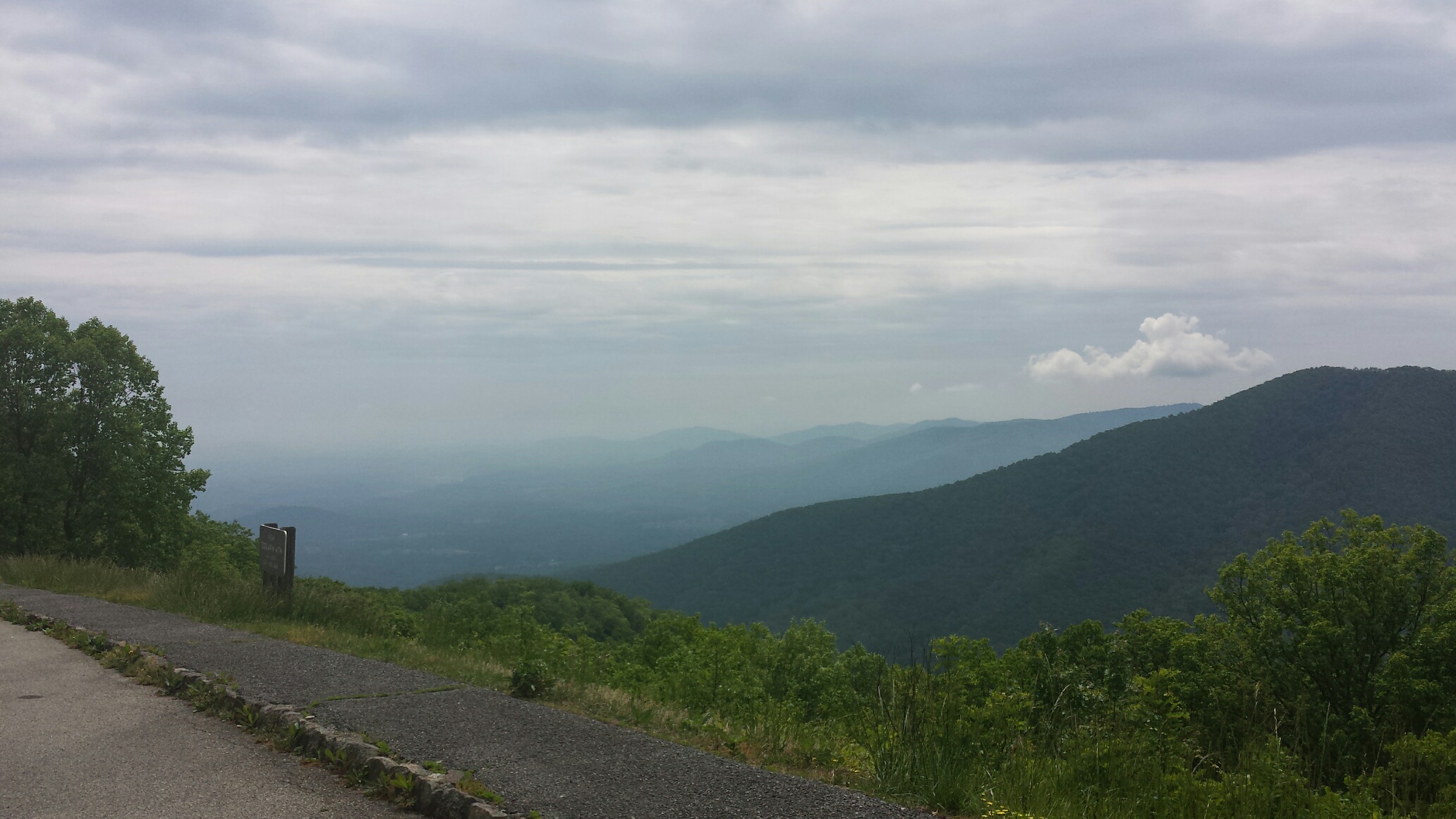
Blue Ridge View – photo courtesy of Deb Reynolds.

6 Pillars Century 2015

Today’s ride: The 6 Pillars Century in Cambridge MD. This is usually the first event on my cycling calendar. Held on the first Saturday in May, 6 Pillars runs from Cambridge on the Choptank River south through the Blackwater Wildlife Refuge to Hoopers Island, then doubles back up the river and circles east, passing through the Blackwater Wildlife Refuge again. The ride itself is tabletop flat, which can take it’s toll on all of a rider’s contact points with the bicycle. This ride is very scenic, taking riders through tidal flats, small towns and open farmland. A rider can expect to see all kinds of birds and other wildlife including Ospreys, Herons, and Red-winged Blackbirds. This year a Bald Eagle made an appearance. This ride is a feast for the eyes. It shows Maryland’s historic eastern shore at it’s best.

The Experience: This year’s edition of 6 Pillars started with a question for my riding friends and I – How much to wear? We tend to start a ride early, and as we gathered at our usual meeting place, the temperature was hovering in the mid 40 degree range.  However, with sunshine in the forecast, and a high temperature forecast for 70 degrees, it was going to get warm by the end of the ride. Anything you start with that you don’t want later becomes dead weight to carry. Everyone had their own answer of course, but I chose to wear a base layer beneath my cycling jersey and arm warmers which I could remove later and put into my pockets. This sacrificed warmth at the start for comfort later; however as I started to warm up on the ride and the sun rose higher, I wasn’t cold for very long.

This year the winds were light at the start. We rode south quickly. My group included Ron Tripp, Deb Reynolds, Eric Sanne, Tony Lehr, Carmen Legato, Carol Linden and John Koehnlein. Some were planning to ride shorter distances due to differences in training or other commitments, but the entire group would be able to stay together until a decision point at approximately 62 miles, so we formed up and rode out, knowing that we would be together for the majority of the ride. I rode near the front of our pack for much of the ride, since I was feeling good. We weren’t moving quite as fast as I’ve ridden in previous years; for many of us, this was our first event and our training wasn’t the best. My own training lacked longer distance rides, though I’d ridden often enough in the spring to have plenty of miles under my wheels. I prepared myself to fight through the full century distance, and the easier pace suited me. The first 40 miles were joyful, with the morning chill leaving me before 10 miles had passed. We arrived at the rest stop at the South end of Hooper’s Island to a surprise: the ride pushed on over another bridge to South Hooper’s Island and turned there. Normally we ride over the bridge anyway, out of a desire to say we rode to South Hoopers, and to enjoy the experience even more, but this time the organizers encouraged riders to cross the bridge to a turnaround point, to ensure that they could get a full 100 miles on their odometers and perhaps to feel the sensation of climbing, which this ride doesn’t readily provide. The turnaround point was painted on the road, but a roadside sign might have served them better.  We passed the turn and rode on for a while, partly to see what was there and partly because we thought the turn point would be better marked.  Quite a few riders went past it. In any case, we weren’t upset; the day was warming up, and we were moving well. Sand fouled my cleats at the rest stop. I had problems clipping into my pedals, and we stopped so I could clean them. I really don’t like to stop a group to do such things, it’s embarrassing, but we all understand the need, so it was okay.   As we returned to the wildlife refuge, we were overtaken by a large group of motorcycles and police vehicles, no doubt part of an organized ride of their own, which prevented us from passing any slower riders while we they passed. By this time the wind was building, so when we were free to speed up a crosswind was working on us until we turned east and it became a tailwind. Other than the issue of a confusing set of arrows on the road which puzzled us briefly, we soldiered on to the next stop, where we had a decision to make.
Carol had a commitment, so she had to take the shorter distance, and Deb was also sure she wanted to take the shorter route. The rest of us were either decided on the full century or leaning that way. The body can do amazing things if the mind will allow it, and the remainder of us all made that decision (easy for some, harder for others) to get the full 100 miles in.
I’ve often said that you can split a century into two equal halves – the first 80 miles, and the last 20. This may not be accurate for everyone, but somewhere between the stops at 62 and 80 miles we all found our focus turning inward somewhat. There is a wall to push past, a place where you need to free yourself mentally and physically to carry on to the end. We all kept up a steady pedaling cadence, pushed on by each other, or perhaps pulled by the prospect of a rest well earned at the end of the ride, and a post ride beer to share with friends. We rolled back to Cambridge in good form,  and celebrated together after that first event of the season. It was a glorious day, made much better by the friends who shared it!

Selections from my mental iPod during the ride: “Industrial Disease” by Dire Straits, “Addicted to Love” by Robert Palmer, and “The Ghost in You” by the Psychedelic Furs.

Stats: 103.61 Miles ridden. A beautiful day, and a ride best described as steady and consistent. A perfect start to the 2015 cycling season.

Rest Stop 1

The first rest stop – still dressed to stay warm!

Scenery

Second Rest stop – looking out over the marshes.

Scenery2

Resting at Hooper’s Island – sadly, standing in sand that fouled my cleats!

Post-Ride

Tired riders, swapping stories and enjoying the sun post-ride.

Bicycle Dreaming

As I write this it’s late February, and another winter weather system is bearing down on me, with a promise of snow and ice and frigid temperatures.  It seems that lately whenever my mind starts to drift, it starts me dreaming of cycling.

This isn’t surprising of course. It’s been a long and cold winter, and that takes a toll on every cyclist. There are 3 ways that I know of to get through the winter – the first is simply to put your bicycle away and hibernate until the spring – which has no appeal once you’re on the roads again, because the hibernators have to grind their way back into condition, and that isn’t any fun at all.  The second way is to ignore winter – there are those who layer up as much clothing as they can stand and just ride through the cold months.  I admire them, because they’re the toughest of all cyclists.  I take the middle route between these strategies.  I spin on a trainer 5 times a week. I push pedals and go nowhere, with the computer registering “phantom” miles. Some riders count these miles. I don’t.  I can’t. To me, that isn’t cycling. It’s several hundred miles per year of going nowhere, and it never feels like I’m cycling. There is no scenery, no feeling of the air flowing by, no feeling of flying, no joy. I can’t use video to fool myself into thinking I’m out on the roads. I can’t make these hours feel like a real ride outdoors. These are hours I spend in a kind of purgatory, alone, pushing my legs and keeping up a base of fitness for that time when the air warms, and my cold weather clothing is warm enough, and I get back on the roads, and the new cycling season starts fresh. If I spin in place, I lose less fitness, and when I ride with friends on those early spring training rides, I hope it will allow me to be in the middle of the group, not laboring along behind it. So I pay the price as the temperature lingers below the freezing mark, and I look impatiently at my calendar, and hope for signs of warmer weather to come, and I spin in place. Spring seems to be waiting just out of reach. I have to be patient. In the meantime, I dream.

As I write this, my bicycle is in the shop for tuning. It’s a good time to do it, while fewer people are thinking about their bicycles. When it comes back to me, my bright red Orbea Onix will have new shift and brake cables, a new chain, the wheels will be trued, the shifting adjusted, and it will have had a general mechanical check-up. This is important every year, and every serious rider will get a yearly mechanical check. However, before the weather warms I’ll have replaced the computer with a model that has an easier to read screen, put on new bar tape, and tended to other fussy little details that are less important when it’s warm enough to just hop on and ride. I’ve been reading cycling websites, and visiting bike shops, and I’ve already purchased all the tires I’m likely to need for the year on sale. In any case, shopping for bicycle gear in the winter is just another kind of bicycle dreaming. When I think of these things, they bring the spring and the riding I crave a little closer.

My email box brings me bicycle dreams on a regular basis. I get notice of ride registrations opening, email from cycling friends to talk of getting together off the bike, and cycling advertisements of all kinds. Some are small reminders, some evoke memories of past rides. I’ve already signed up for two rides this spring – and the memories of those rides from past years weave their way into my cycling dreams.

In my bicycle dreams I’m free – the road rolls and the scene changes; the sun is warm, the breeze is inviting, there are friends riding along, and my breathing is good and it feels like I’m being pulled along with the experience. Every spring these dreams will come true, but for now, with the snow and the wind chill keeping me indoors, these are the dreams that keep me warm.

Shelter Century Fall Foliage Tour

Today’s ride: The Shelter Century Fall Foliage Tour is a charity ride out of Easton, MD. The majority of the ride is on the eastern side of route 50, with stops on the Choptank River and pastoral views. The ride also features a ferry ride across the Tred Avon River from Oxford MD to Bellevue MD, and while the course is not challenging for terrain, the challenge of this ride is coping with the wind. The ride itself is flat as a tabletop, and very scenic.  The finish promised homemade pies! 

The Experience: I was recovering from the flu when I set out alongside many of the usual suspects on this ride; Ron Tripp, Rita Spence, Eric Sanne,  John Koehnlein and Tom Roman. A wise man would not have ridden 100 miles in that condition, but I am a stubborn man, not a wise man.  I felt okay at the start, so I convinced myself that I’d be okay to go the distance. The batteries in my computer were wearing out – in the cool of the morning my display cut out, though it came back when the temperature warmed up, by which time it wasn’t of much use to me. None the less, the weather was beautiful that day, and I was still feeling fine, and I just turned the cranks and enjoyed the morning. There were no road marks for this ride. Only signs placed at turns, so the cue sheet was important. Had there been more of the signs, that would have been no issue, but there was only one sign at turns, and with crossing routes it was important not to miss a sign, so consulting the cue sheet was very important. In the first 50 miles, there were 3 rest stops, all of which were on the water with great views. The problems were logistic. The stop at 50 miles ran out of water and gatorade; two things no rider wants to be without. In the last 50 miles, there was only 1 rest stop, at the ferry landing in Oxford at 77.5 miles.  In a ride where you’re battling headwinds, 27.5 miles is a long way to go without a break. Thankfully the day wasn’t hot, which would have made matters more difficult. A water stop would have been welcome to break that segment up.  However, my personal condition was a more questionable matter. By 70 miles I was having real trouble breathing; the flu wasn’t completely through with me yet and struggling into the wind took a lot out of me.  Thankfully after the ferry ride the winds were with us more; I rallied a little. John kept an eye on me as I suffered through the final 5 or 6 miles;  but I managed to complete the ride and earned the rest at the end.  Had I shortened the ride to a metric century, my body would have been happier. Had I not ridden at all, my body would have been happier still.  But as a stubborn man I simply couldn’t let myself heal. While I paid the bill for that the following day, on that day the ride was inviting, so I soldiered on.  Had I been in better health, I think I would have enjoyed this ride a lot more than I did, and I found a lot to recommend about this ride despite the organizational deficiencies. 

Selections from my mental iPod during the ride: “And if Venice is Sinking” and “The Hammer and The Bell” by Spirit of the West,  and “Panic” by The Smiths. 

Stats: 101.5 Miles ridden.  A good day to ride, through a scenic area with a ferry ride to make it memorable. 

First_Stop

At the first rest stop, in front of course maps.

On_the_Ferry

With John on the Oxford Ferry.

Seagull Century

Today’s ride: The Seagull Century is one of the largest cycling events in the country, drawing over 8000 riders to Salisbury on Maryland’s eastern shore.  It’s been held for over 25 years, and it’s connection to Salisbury University makes it well staffed and supported. In many ways, 8000 riders create a critical mass of cycling culture. The event actually begins on a Friday, with shirt pickup, optional group rides around the area, and exhibits by vendors in the gym.  It’s a time to build excitement, catch up with friends, and shop for items you may want for the next morning. The growth of ridership has created the need for three options; two century courses and a metric century.

The Assateague Century Course runs south and then east to the coast, with a rest stop at Assateague Island at mile 60. It is the classic Seagull route. it was the first route and still the most popular, with the highlight being the chance to wade in the ocean and see the wild ponies that roam on Assateague Island.

The Snow Hill Century was created several years ago. It has some common elements to the metric century, and runs south through the town of Snow Hill, riding past small rivers and inlets that are a feature of Maryland’s eastern shore. The Snow Hill course has the advantage of being much less crowded while being just as well supported.

While I have never ridden the metric century (62 miles), some of that course is common to the  Snow Hill Century route.

The main feature of the Seagull courses is that they are flat as a tabletop. For some riders, who dislike climbing, this is a draw. I don’t see it as an advantage. Hills change your position on the bike, and therefore courses that have rolling terrain or climbs aren’t as hard on the places you contact the bike – hands, feet and seat. Hills also give you the opportunity to coast a little more and work slightly different muscle groups, while flat courses require you to apply power more consistently using the same primary muscle groups. The other main consideration for the Seagull is wind. I’ve ridden alone at the Seagull, and it’s much easier to have a friend to ride behind occasionally so you can rest out of the wind, but more about that later. it’s important to remember that a head wind is like a hill without a summit.  It is important to prepare for windy conditions at the Seagull Century.  The Seagull is usually the first weekend in October, and while the mornings are usually cool, the day warms up quickly and many riders over dress at the start. It is a better idea to dress for mile 5, by which time you’re warmed up.  Anything you would prefer not to have to carry for 95 miles should stay in your car.  You won’t stay cool long.

The Seagull Century was my first century ride.  My experience isn’t uncommon – a lot of riders choose the Seagull as their first century, and in many ways it is an excellent choice. This is a very well supported ride.

The Seagull is also a place where inexperienced riders congregate, and in many cases it is one of the few times all year that a rider will have a chance to ride in a group, much less a line.  The sheer number of riders can be an issue, in the beginning where you can get in each other’s way, and on the open road where It can spawn a kind of “Tour De France” syndrome – where a rider will jump in with a fast pack and burn out, split a line, or form an ad hoc group made up of people who want to ride in a group to draft a little and save energy, but have no idea of how to behave in a group, or what to expect of the other riders around them. That can be very dangerous.  I ride with a group of friends who are experienced group riders. We ride together all year, so often that we know what to expect of each other. We’ve learned what to do and what NOT to do, at the front (pulling) at the back, and within our line. We signal each other, call out hazards, pass information down the line as we slow or stop, and call out traffic. We stay together and ride consistently and predictably.  This requires experience and practice. It only LOOKS easy. There is a lot of information available about drafting and pace lining, so I won’t write a lot more about it now, but suffice it to say that some of the best and worst examples of how to behave in a line of riders will be on display at the Seagull, and it’s a good idea to know how to ride in lines and approach them with respect, and better still, to ride only with people you know and trust.

The Seagull finishes on the Salisbury University campus, and riders go through a tunnel under Route 13, past the beer garden tents, and under the finishing banner. Riders finish to the cheers of an enthusiastic crowd and live music. The beer garden itself, with a band and a general air of celebration, is a feature of the ride that adds much to the experience. There are options other than beer to drink of course; but the atmosphere at the finish of the Seagull Century is an experience to look forward to in itself.

The Experience:  2014 was a very organized Seagull for my teammates and I. We had reservations for dinners on Friday and Saturday, and a meeting place where we could all get together and ride out on the Seagull course together.  We all chose to ride the Snow Hill century, since the course was better shaded, less crowded, and the lines for water and gatorade were not so very long.  However, every Seagull is crowded at the start and finish, and choosing a good meeting place is important. It seems as though most riders meet up in front of the gym – we chose not to do that, since it was the cycling equivalent of a sticky trap – there are so many people waiting there that it is difficult to move past the gym at all.  We all met up at the far side of the tunnel across the street, which worked much better. This was my 9th consecutive Seagull Century. I’d ridden it every year since my first Century in 2006.

We rolled out onto the course well before 7:30, and starting early means you spend more time riding while the temperature is most comfortable. It was a cool and sunny day with a little wind, but not a hard wind. Perfect conditions. Carol Linden started out briskly, looking for a comfortable gap between knots of riders, and we stayed together behind her for the most part until those knots of riders thinned out a little. I was feeling very good, and so when the ride opened up, I went to the front and took a long pull, setting a steady pace for our line.  We had a big group to start, with myself, Carol, Ron Tripp, Eric Sanne, Rita Spence, Rita Bell, Russ Altemose, Carmen Legato and John Koehnlein. I called to other friends as we passed, and the miles started slipping under our wheels smoothly at what seemed a far faster pace than we were actually riding.  We passed fields and farms, and even a big Blue Heron at a pond at the roadside, and we were at the first rest stop at the 20 mile mark while still feeling comfortable and strong.  At the first stop we split up with John, who was looking to ride at a faster pace, and Russ, who had agreed to ride with us to the first rest stop and then take up with some other riders for the remainder.  Russ is recovering from cancer, and riding 100 miles at the Seagull was a big step for him. Riding a slower pace was sensible for him, since he had less time to train.  Riding that 100 was a triumph for him though, and we were all glad to share in it.

After the first stop, the Snow Hill course sent us away from the other rides for the most part, and we continued at a good comfortable pace. We had picked up some riders at the end of our line, but they turned out to be very considerate, and members of our home club, Potomac Pedalers, though we hadn’t met them. They let us in front of them as we came back off of the front of the line, and drafted politely behind our line. When we got to the next stop, they complimented us on our line. The water stop by the Pocomoke River wasn’t crowded, and we made it a short stop and headed out toward Snow Hill with good cheer all around. By the time we got to Snow Hill, the only real problem among us became obvious. Ron was getting a click in the bottom bracket of his bike – a potential problem with the bearings. The park at Snow Hill was a great place to rest, and we took full advantage, enjoying cranberry and blueberry pound cake and filling up our bottles. We headed out again as the day began to heat up. This was the longest leg of the ride, but even as the day warmed up, we remained comfortable.  By the time we had ridden 70 miles,  it was obvious that Ron’s bike was getting worse. He abandoned at mile 75, before the final rest stop at Nassawango Golf Course. In the meantime, it was obvious to me that I was still riding strong, and so were Eric and Carol.  The final rest stop was welcome for the pie and ice cream, though we were sad to see Ron waiting for a ride back to the University. The final leg joined the Metric course, and we overtook a lot of riders as Eric, Carol and I took turns pulling the line back to Salisbury.  I rode in strong, feeling the joy of completing one of my best Seagull Centuries ever.

The celebration in the Beer Garden afterward was exceptional. Eric and I spent some time cheering for riders coming out of the tunnel, hoping to see Russ finish, but he slipped in before we got to the rail. We cheered for everyone anyway. One of the things that make the Seagull unique is the cheering crowd at the finish, and being part of that made me feel good. With the exception of Ron’s mechanical problem, we all had a good ride, and my 10th century of 2014 was one of the most memorable.

Selections from my mental iPod during the ride: “Poor, Poor Pitiful Me” by Warren Zevon,  “Just Like Heaven” by The Cure, and “Cynical Girl” by Marshall Crenshaw. 

Stats: 101.59 Miles ridden.  With a combination of ideal weather conditions and feeling strong all day, and with good friends to share the experience, this was a ride to remember.   

Ride_Start

My teammates on this ride – Ron Tripp, Rita Bell, Carmen Legato, Eric Sanne, myself, Russ Altemose, Carol Linden and John Koehnlein.
Snow_Hill_Stop

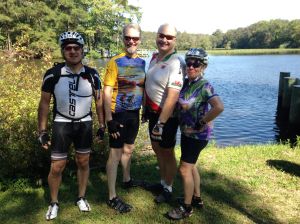
Carmen, Eric, myself and Carol at the Snow Hill rest stop.
Golf_Course_Stop


At the final rest stop.

John&Carol

John and Carol in the Beer Garden post-century.

Post_Ride

Relaxing in the Beer Garden after a terrific ride.
PPTC Back Roads Century

Today’s ride: The Back Roads Century is held at the end of September in Berryville Virginia. The century course has two loops; 50 miles north through West Virginia, and another 50 miles south through Virginia. The metric course uses the south loop, and both loops give you great views of the Blue Ridge mountains.  The course is rolling, and the century has approximately 4000 feet of climbing, with more climbing on the south loop than the north. Starting early is a good idea for this century, and the morning is typically cool, but the course loops back to the start, so any jackets or warmers you take on the north loop you can remove before the south loop. The roads are mostly rural, and there is seldom traffic to worry about apart from the times when he ride crosses local highways. The rest stops are well done, with special treats like salted baked potatoes and tomato and cucumber sandwiches.  Potomac Pedalers Touring Club holds this ride, and the volunteers do a good job for the riders. 

The Experience: I arrived before dawn, having gotten up early and driven for an hour and a half to arrive at the start before many of the volunteers. I prepared to go in the early light, and rolled out with Carol, Eric, john and Carol’s friend Johanna.  The morning was cool, and I wore arm warmers for the first loop.  The local authorities chose to crack down on the cyclists on the ride, and some riders were ticketed, but it seemed to me that they were being antagonistic.  John got going quickly with other riders, but the rest of us stayed together. We rolled into West Virginia and made it into the first rest stop at a good pace. The day was starting to warm up, and we headed back toward Berryville with the mountains around us lighting up as the sun rose higher overhead.  We finished the first loop easily, with Eric and I getting out ahead of Carol and Johanna on the climbs.  We joined up again for the start of the second loop, and John stayed with our group, but Johanna began to feel ill and abandoned. The rest of us collected ourselves at the 62 mile rest stop. Once again, Eric and I stayed together, with Carol and John pacing each other behind us. With the heat building and the road rolling, Eric began to slow. He had been on vacation and had been off of the bike for a few weeks, so as the road rolled, I stayed with him as much as possible to keep the team together.  We got a break at mile 79, as well as some fabulous tomato sandwiches, and attacked the next set of rollers.  We were past tired as we made it to mile 92 and the final rest stop, and had some shaved ice to cool down. John and Carol found us before we left, but we set back out and rode strongly for the final 8 miles.  The rolling terrain was a challenge in the last 35 miles, but the views of the Blue Ridge were spectacular, and the weather favored us to help make this year’s Back Roads Century another memorable ride. 

Selections from my mental iPod during the ride: “If I Didn’t Love You” by Squeeze,  “What Difference Does It Make” by The Smiths, and “Obscurity Knocks” by the Trashcan Sinatras. 

Stats: 100.54 Miles ridden.  The day showed us the best of the Blue Ridge.     


BRC_Rest

A scene from the rest stop at Mile 62.

BRC_Crew

The crew that rode the Back Roads: Carol Linden, John Koehnlein, Eric Sanne, and myself.

Indian Head 100

Today’s ride: The Indian Head 100 out of Indian Head Maryland is a century for riders that is organized by riders, and it shows. The Oxon Hill Bike Club, which sponsors the event, has made this ride a good experience for the participants. The course is rolling, and the rests stops are scenic, with river views at the rest stops and excellent food. This is a Sunday ride on the first weekend in September, and it can be hot, but the course is well shaded with plenty of scenery to look at.  

The Experience: This was my second century on consecutive days. 200 Miles in a weekend is difficult, but many of my friends and I ride back to back centuries as a challenge.  The night before Indian Head, a front swept through the area, cooling the temperature and pulling the humidity out of the air. Despite having to cope with tired legs, a large group of friends got together to roll out early from the community center at Indian Head. Not all of us were on the Century course, and one was coming back from cancer treatments, but Indian Head is a classic ride, and the conditions couldn’t have been better.  We got right to the climbing and negotiated the first section in good form. Yellow wildflowers were growing thick on the roadsides, and we all got to the first rest stop together while riding strong, We had our fill of the famous egg, ham and cheese sandwiches on english muffins at the first stop. The century riders split with the riders on shorter distances and headed out to ride the rollers on Riverside Road, which is a classic stretch of road that puts riders on a shaded roller coaster for nearly 12 miles. The second rest stop came soon after, and Ron, Tony Lehr, Rita Spence and I kept up a good pace and came into the rest stop riding well. We refreshed ourselves and headed out on the long leg to St. Ignatius Church, and more wonderful views over the Potomac. The course led us to the Thomas Stone House rest stop after a climb up Rose Hill, and with 10 miles to go and the scenic Indian Head Rail trail ahead, we finished our back to back century weekend on the trail with views of the wetlands around Indan Head. One of my favorite rides came though for me again.

Selections from my mental iPod during the ride: “The Perfect Girl” by The Cure,  “Cliffs of Dover” by Eric Johnson, and “I Saw Her Standing There” by the Beatles. 

Stats: 100.22 Miles ridden.  A perfect weather day.  

IH100_Group

Our group the first Rest Stop. Left to right – Tony Lehr, Russ Altemose, Myself, John Koehnlein, Ron Tripp and Rita Spence

IH100_ST_IGN

The long view from St. Ignatius Church over the cemetery. The rest stops have views of the river.

Amish Country Bike Tour

Today’s ride: The Amish Country Bike Tour starts in Dover DE, at the town square. The ride rolls out of town and through Delaware’s Amish country. This is a relatively flat ride along country roads, and because it is held the first weekend in September, it’s often hot.  Since the country you’ll ride through is open, you have to cope with winds as you ride. Among the attractions are homemade pies served at the second rest stop. The riders get a barbecue meal after the ride.

The Experience: Once again, I rode with my friend Ron Tripp, and Rita Bell. Unlike our experience with the ShoreFire Century, we ride with three of Rita’s friends from Sussex County Cyclists in Southern Delaware, where the pace of life is slow, but the pace of riding is very fast. We rolled out well before the mass start that was scheduled for 8am, but we had quite a bit of company on the roads as we made the most of the cool morning. At the first rest stop Michelle, her friend Jay and her other friend Jay joined us, after which the pace increased. I can’t be too upset by that, despite the fact that Ron and I would ride another century the following day (more on that in another post) we all felt good that early in the ride before the heat built up. We all enjoyed a slice of homemade pie at the second stop (I had the peach pie – it was heavenly) and rode away as the heat of the day began to build.  By this time pace became both friend and foe; the motion cooled us, but when the wind wasn’t with us, we were using a lot of energy.  When we got to the third stop in Felton, DE the heat was getting oppressive. When there is little shade and the heat and humidity is high, the pavement is the sun’s anvil, and cooling off is important. We set off on a short loop that would take us back to Felton, and we were drinking often, but on that section, young Jay from Sussex fell prey to the heat, and his teammates looked after him while Ron, Rita and I rode back to Felton.  Some of those at the stop had begun their ride with the mass start, and still had to ride the short loop back to Felton in the high heat. I poured water over myself to cool down while I silently praised our decision to leave earlier.  I was drinking a lot, but it felt like I was barely staying cool enough to avoid a bonk myself. The ride back into Dover was a straight road with a tailwind, and despite the heat we managed to ride strong all the way back to the square in Dover.  Our friends all made it back, after Jay recovered from his difficulties, and our Amish Tour was complete.

Selections from my mental iPod during the ride: “Just Play Music” by Big Audio Dynamite,  “Til I Hear it From You” by The Gin Blossoms, and “I Have the Touch” by Peter Gabriel. 

Stats: 100 Miles ridden.  The heat and humidity made it impossible to drink enough, but we managed to stay cool enough to finish comfortably.  

Pies

A Selection of homemade pies at the second rest stop.

In_Felton_DE

Holding up a wall in Felton, DE.