Category Archives: Cycling

Resolutions

Another year, another set of resolutions. It’s very cold outside on New Year’s Day, and despite this, I’ve already started thinking about resolutions. Yes, they involve cycling. That’s because it has a direct effect on my health. The older I get, the more I think that the time I spend on the road cycling with my friends is an investment in a long and healthy life.  As it is, I’m working out in the gym, but eventually the thaw will come, and I’ll be back on the roads, where I feel the most free.

Since life is a precious thing, I’m going to do what I can to improve the quality of my life. So my goal is to continue to ride and celebrate with my cycling friends.  I’d also like to ride at least half a dozen Century rides – and I’m already signed up for the first of them! I’m also going to see if I can find a ride that I haven’t done before to try out this year.

These are modest goals, but they’re achievable, and they’re things I believe in. They’re the kinds of resolutions that make sense to me, and they’re an integral part of the quality of life that I look for.  2018 will be another joyful year if I keep them.

How much does your bike weigh?

CAAD12

I get this question occasionally. In fact I was asked again recently. The people I ride with don’t ask about these things much, but sometimes new riders or people who know I cycle seriously will ask, and it’s an interesting topic of conversation. Among cyclists, it’s a loaded topic.

The answer in real terms is about 18-19 pounds.  That’s light enough for me. Most people think the bike is very light, particularly when they pick it up. Bike weight is important because you have to overcome the forces that work on you as you pedal.  The classic example is riding up hills.  All other things being equal, the less weight you have to take up that hill, the easier it will be. It has an affect on other aspects of riding as well. So being large means that I have to apply more force to move myself and the bike. Physics can be cruel.

Racers want the lightest possible equipment, but I don’t race. Light weight comes at a price.  The lightest bikes are the most expensive to produce, they are also more fragile because of that weight saving, so a rider as big as I am can ride a superbike, but I  would put some serious strain on it, and unlike top end riders who race on a superbike, I’m far less aerodynamic. Think of it like using an expensive Ferrari supercar to pull a trailer.  You might have the horsepower to do it, but it wasn’t what the car was designed for. So even if I had the money to ride a superbike, I’m hardly the guy to take advantage of the performance gains it may offer.  Having said that, it FEELS nice to ride an expensive bike.  You can’t deny it. So as far as I’m concerned, I think people should ride the nicest bike they can afford.  You’ll want to ride it, and that’s important.

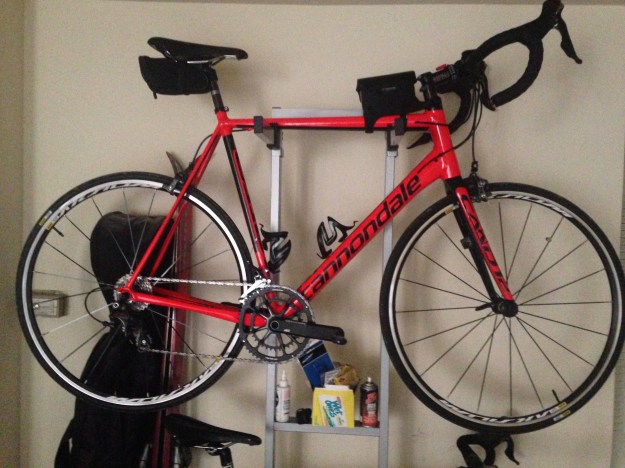
I ride a high quality aluminum framed bike (pictured above). Carbon fiber frames are more expensive, exotic and lighter as a rule, but high end aluminum and low end carbon overlap in price, and even in weight, and high end aluminum is less expensive to produce, so for the same price you can get better components (drivetrain, shifters, brakes) than you can on a carbon frame of similar weight.

My wheels are actually custom – built for strength.  I have no illusions about the utility of low weight components for my riding style.  I rely on power.  Power is torque and strain on my bike.  Material strength is more important to me than weight at this point.

Bike weight doesn’t mean much to me, and my next bike is likely to be heavier than the bikes I currently ride, since I’d like to ride a custom steel bike. Steel is denser than aluminum, so steel frames tend to be heavier, but I’m sure the advantages of a bike built to suit me and my riding style will be worth a little extra bike weight.


Big Cycling Events

My first century ride was at the Seagull Century in 2006.  I’ve ridden every Seagull since then, with the exception of 2015 when the event was cancelled due to a hurricane coming up the coast. The Seagull is one of the largest century rides in the US.  There are larger rides, such as the “Hotter than Hell Hundred” in Texas, but the average century ride will have less than 3000 participants, and the Seagull typically draws more than 7000, particularly if the weather is good. It’s a flat ride, and while that presents it’s own challenges, the lack of hills makes it popular to a lot of riders. Big events draw a wide range of people and they create some unusual riding conditions.  You’ll often see both the best and worst of cycling on display at events like the Seagull, and this year was no exception. Big events can be dangerous environments. I have friends that don’t like riding the Seagull.  It’s flat, which means you’re constantly pedaling, not coasting, and it puts stress on your contact points with the bicycle – hands, feet and seat. But it’s also a fun event with a lot of activities and despite the crowds, it can be a great time.
Assateague1

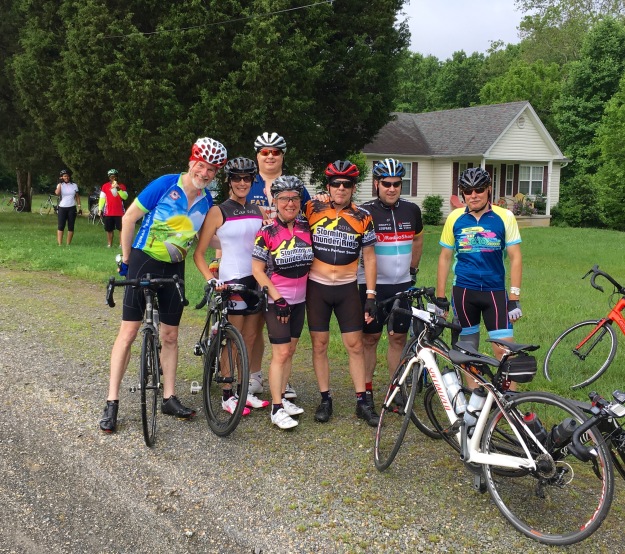
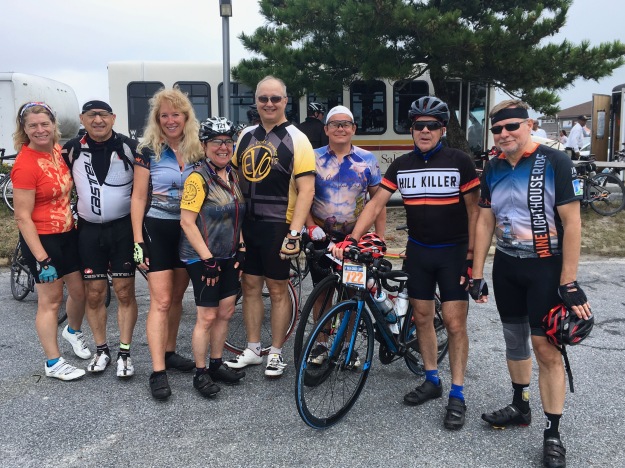
From left to right: Amy, Carmen, Stephanie, Carol, Myself, John S, John K and Ron at the Assateague Island rest stop during the 2017 Seagull Century.

I have the good fortune to ride with good friends.  We all know the risks we face, and how to minimize them. We communicate well, we ride within the conditions, and we know our limits. This doesn’t come by accident. We have experience that has been hard won and passed among us through stories, lessons and advice over many years. We’re aware of what to do, what not to do, and what to avoid. This year we had a first timer with us. Amy had never ridden a century, but before she started she already had more information about what to expect than most new century riders and many experienced riders.  Even so, she had questions afterward, and they were good questions. Between the experience and the information, I think she has passed the “beginner” phase, because she has the information she needs and the experience to know how and where to apply it.  In this post I’m going to try and relate a few things about the art of cycling, and I should state for the record that my knowledge is not comprehensive, though it is extensive. We’re all still learning.  I’m going to talk a lot about my ride at the Seagull this year, but much of what I’ll relate will apply to large events. They’re unique in many ways. Some of those unique elements are good, and others less so.

There is limited room on the typical road to accommodate cyclists, traffic control can be a thorny problem at big events, and a big event draws everyone from the least experienced newcomer to the seasoned bike racer, and if you’re not aware that there is an art to the game, you won’t learn it at a big event.  The difference in styles between the riders in limited spaces expands the chances for accidents and makes being alert and careful much more important than many riders realize. Many riders, through no fault of their own, make elementary mistakes simply because they’re not used to riding events at all, much less events with so many other people to cope with.  There are places where you can expect to see problems at a big event.  Here are 4 of them:

  • The start
  • The early miles up to the first rest stop
  • Crowds around rest stops
  • The last quarter of the course

This is a common sense list, and it applies to any event, but at a big event like the Seagull Century, problem areas are multiplied by the sheer number of riders. The chance for trouble if you’re not careful is much greater than at smaller events. At the start, riders stand or mill around looking for friends. Some are eager to leave, others are lost, some are looking around for people or frantically calling or texting others to find them. Some are socializing. In short, it can be a maze of distracted people.  My team met before the start, and got going together. It takes some coordination, and we had to slowly make our way from the campus of Salisbury University where we parked to the place where we found open road ahead of us.  Rides are usually “show and go” and many people will leave early to avoid crowds, but some will socialize as they gather, and the chance to get split up or stopped is good. The lesson from experience is to go slow and have a plan.

The early miles of a big ride like the Seagull Century are always tense. Legs are fresh, riders are excited, and adrenaline flows. Some want to complete their ride in 5 hours, some just want to finish. Some ride side by side and talk with their friends, leaving much less room to pass them safely. Others find themselves charging ahead as though they’re racing, forgetting the way they trained and using more energy than they might otherwise. It’s a chaotic time. My friend Carol has a talent for finding open spaces between knots of riders at the start of the Seagull.  We trusted her to find us a clear path, and she rode at a strong pace. Riders begin to string out after a few miles, but there are still an abundance of them. Not everyone will let faster riders pass. Not everyone will pass safely. This year, the first segment of the ride was through a mist or very light rain. That created problems as well. By the first stop, the rain had ended, and the roads were starting to dry.

Rest stops are another trouble spot. They are choke points, with riders slowing and stopping, getting in each other’s way, forming queues for water, food, bathrooms and bike service if it’s available.  Most riders won’t skip a rest stop, and most will charge into the first rest stop while still feeling strong. The general chaos as riders stop and go is common to any rest stop, but the more people, the more chaos.  Getting what you need and starting again without cooling down too much is important. In our case, we had become separated by the first stop, but we managed to regroup, resupply and get out without any delay. When we got going again, there were still a lot of riders on the course with us, but the riders thinned out because of the rest stop congestion. It felt like we had more room to ride in. By this time the riders on shorter courses were also separated from the Century riders, and riders were settling into a pace. Managing rest stops is an art, but if you’re careful, you can make it through even the most congested rest stops without accidents.

In the final miles of a century, riders have usually become so tired that they lose focus. The final 25 miles of the course is another place where you have to pay attention. By this time your body has had to refuel and if you’re not eating and drinking enough as you go, the chances of you losing focus and crashing increase. I heard about a crash that required an ambulance in the final miles. It wasn’t a surprise to me. With a lot of tired riders close to each other, mistakes are easy to make. Thankfully, by the end, the road tends to be more open.

The Seagull gets it’s share of accidents because of the sheer number of riders.  These are usually avoidable. Entering the second rest stop, volunteers asked riders to dismount and cross the train tracks at that point because of large gaps there.  One rider apparently crashed trying to ride over it rather than dismounting. We saw a crash on the road between the second rest stop and Assateague island, with a rider going down after touching wheels with another. One of the riders with the rider who crashed turned his bicycle perpendicular to the direction of travel to look back at her, partially blocking the road. That wasn’t the way to help. Inexperienced riders often make mistakes when riding in the middle of groups, because they seldom train in groups. You have to be careful around them.  Finally, what you’ll find at big events are people who try to draft others without knowing the first thing about drafting or riding etiquette. The pros make drafting look easy. So too many clueless riders think it’s easy.  It isn’t. Neither are these events races. They shouldn’t be approached like one. A lot of riders end up trying to save some energy by wheel sucking – which means they cling like a leech, without saying a word, as if they have a right to be there, or they’re just doing you a favor by riding close behind you without saying a word. They form up lines without a clue as to how fast they’re going, and they sometimes burn out early in the ride – all because they think they know what they’re doing. They’re not interested in pulling you along – only saving energy by following. Do they introduce themselves and ask if it’s okay to ride along with you? No. They think they’re doing fine. The best thing to do is drop them. Ride them off your wheel. I like to show them all the courtesy they show me when they latch on to my wheel without communicating.  Which is essentially none, but you have to understand that most of them are just ignorant. They don’t even realize they’re being rude. Big events like the Seagull concentrate these lost souls.
Finish_Line

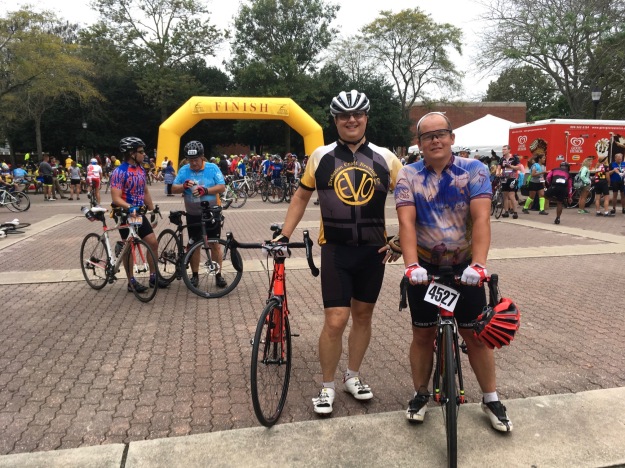
At the finish line with John S. We earned our beer!

Despite the dangers, my friends rode well.  We were together for much of the ride, but Amy, Carol and Stephanie all had injuries to care for by the end and we split up and got to the finish in smaller groups. I finished as strong as I could with John, and we all gathered at the beer garden afterward. It was a fun ride, and a good experience with good friends. One thing I have to say for my friends is that we know how to celebrate!
Cycling along the Coast of Maine

Portland_H_Light

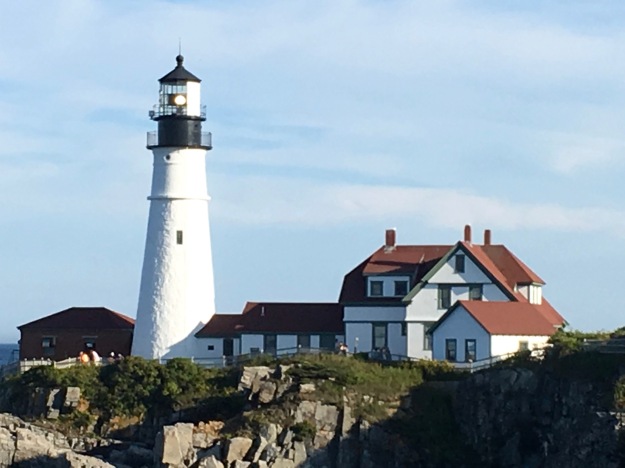
Portland Head Lighthouse

For the third year running, I have gone to South Portland Maine in early September for the Maine Lighthouse Ride. This is a century ride that begins and ends at Southern Maine Community College in South Portland, and over the course of 100 miles passes 9 lighthouses as it winds it’s way along the coast from Portland south to Kennebunkport and back again. This ride is the most scenic and enjoyable experience on my cycling calendar.

The ride is gently rolling, and while there are a few climbs that will make you work, the hills are either short ramps or gentle grades and all have corresponding restful descents. The sum total of climbing for this ride is approximately 2600 feet over the course of 100 miles. The average recreational rider can manage this ride with appropriate century training and preparation, and shorter options are available. The ride itself is well supported, with road markings and signs that are easy to follow.  Route maps are available for GPS computers as well. Riders can rent road bikes from bike shops in and around Portland if needed. That’s all the technical information any rider needs; what really sets this ride apart is the scenery and the experience.

The ride begins on the Campus of Southern Maine Community College in view of the Spring Point Ledge lighthouse at the entrance to Portland harbor. Riders go to the Portland Breakwater (Bug) Light, and move away from the waterfront in South Portland along the eastern trail. Riders are asked to start at particular times based on the distance they’re riding to help ease congestion at the start, and there will be some congestion as you ride out, but despite this the early miles will reward you with some fine scenery, and it’s worth the patience required as you go through South Portland.

Kennebunkport_stop

At the rest stop in Kennebunkport

Be patient and careful until you find open road where you can safely increase your speed. The ride itself is run by the Eastern Trail Alliance, so it’s no surprise that this century is run on some of it’s trails.  Faster riders will want to get to the front of the pack at the start time, but it pays to be very careful, patient and keep your phone cameras available. Photographers should be very careful not to obstruct other riders when they stop for a photo, since some of the areas you’ll ride through are narrow, particularly in the early miles.

The route continues inland, heading toward the causeway over the Scarborough marshes. This is a two mile section of compacted sand and gravel pathway, and while that might not be easy for narrow road bike tires, (pro tip: make sure your tires are in good condition before you arrive) the surface poses little problem if you ride it at a slow speed (10-12mph). Volunteers will be nearby to help you if you need it. While crossing the marshes, take a moment to notice the water level. You’ll ride through twice, and chances are that tidal conditions in the marshes will have changed by the time you return to cross the causeway again.  After the marshes, the ride takes you to the first rest stop at Old Orchard Beach.

Fortune_Rocks

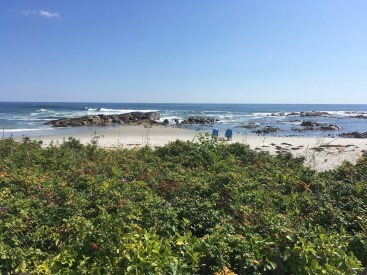
The beach from Fortune Rocks

The next leg sets out through Old Orchard Beach before heading west through the towns of Saco and Biddeford and into the countryside until you reach Kennebunkport. This marks the southernmost part of the ride. After a stop outside Kennebunkport, riders go through the town and head north along the rocky coast, meandering along around the inlets and marshes. At this point you’re rewarded with views of mansions, harbors, inlets and rocky shores. Shrub roses grow in the sandy soil by the roadsides, and those that aren’t in bloom display a riot of colorful rose hips. The route winds along the coast past Fortune Rocks, back through Old Orchard Beach and across the Scarborough marshes again. You’ll go to Cape Elizabeth, and through Fort Williams Park to Portland Head Light before you return to the start.

Cape_E_Light

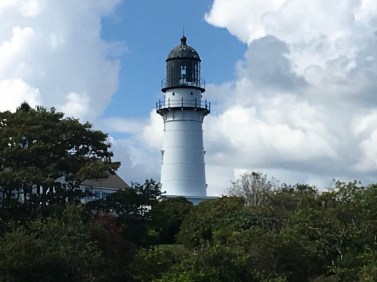
Cape Elizabeth Lighthouse

All along there will be places where you can view and photograph the lighthouses. You might miss one or two if the weather isn’t clear, but they’re out there, and the route passes them. Goat Island Light, Wood Island Light, Cape Elizabeth Light (East & West), Portland Head Lighthouse, and the Ram Island Ledge Light. The coastal scenery never disappoints.

The weather can vary widely. You can expect cool mornings, heat or rain. Southern Maine in early September is on the cusp of a colorful Autumn, and you’ll find the trees starting to turn color in places. Come prepared for differences in temperature between start and finish. You can expect good route markings, good support, and post ride food along with locally brewed craft beer. Portland provides many other distractions – you can browse the shops and restaurants along the Portland waterfront, take a boat ride through Casco Bay, or drive 20 minutes North to Freeport and the L.L. Bean Home Campus to shop the outlet stores. The salt air, the scenery and the fellowship among the riders and volunteers make this a memorable event. Enjoying the coast of Maine by bicycle is a unique and rewarding experience.

Getting Serious

Everyone I know has said it at least a few times, for a variety of wants: “It’s time to get serious about my…”
It’s an all purpose lament that could be brought about by a desire to get in shape, lose weight, save money, change jobs, finish a project, work on a hobby or anything else that we feel the need to accomplish.  I’ve told myself that I’ll get serious about a number of things, and as I have, life has interrupted me.

No sooner did I get cleared to ride again after my surgery than I had a family tragedy.  My father passed away at 83. This was expected, but such news is never welcome. So it was that my time to get back into shape was delayed. Still, when life calmed down I got back on my bicycle in a sincere effort to get back into shape. What I discovered was a pleasant surprise. In the run up to surgery, I discovered that I’m diabetic. That was a shock, but managing it has had a welcome effect: I lost 20 pounds.

My first event after I’d come back, for which I had virtually NO preparation, was the Patuxent Rural Legacy Ride. It had been 5 weeks since I’d been on the bike for more than a few short miles.

Pax

Eagle Harbor stop at Pax Legacy.

I wouldn’t have missed that ride for anything, because I love the event, but I was worried about fitness, and I was prepared to ride 40 miles instead of the full 64 simply because I wasn’t sure what I was actually capable of, and even 40 sounded tough. I thought I’d see how I felt.  To my surprise, I felt good. I rode the entire 64 miles and  enjoyed myself.

It seems that two things were actually working in my favor.  The first was the weight loss. 20 Pounds is more than the weight of a modern bicycle.  I haven’t lost all that much strength, so climbing hills was actually not as much of a chore as I might have thought.  The second thing was base mileage.  When you ride consistently, you build up a fitness base. This begins to erode when you have to take time away from your exercise, but it doesn’t completely go away, and building back up isn’t quite as hard as building that base in the first place.  My base miles were still in evidence, so the transition from inactive to riding more serious mileage wasn’t quite as difficult as I thought it would be.

June and July went by without any serious training headaches.  I was slowly building back up, and feeling positive.  Meanwhile some of my friends, who also have had difficult years, were feeling the strain. Where I had lost weight to compensate for my lack of training, they had gained weight due to injuries or circumstance, and were struggling to get back to the fitness level that they had last year.

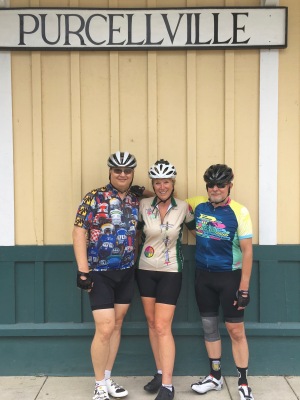
Purcellville

Halfway through our ride.

With a cycling trip to Maine coming up in September, as well as other events in the fall, they felt it was time to get serious too.  So it was that we made an effort to get miles under our wheels.  The big test came last weekend on a trip from my friend’s residence in Chevy Chase, across the Potomac into Virginia, (meeting another friend on the way) and cycling up the Washington and Old Dominion trail to Purcellville.  A round trip of 105 miles.  I don’t usually enjoy the W&OD trail.  As a former rail bed, it’s largely straight, and it’s used by a lot of people and can be quite crowded, which is often difficult.  However this time it wasn’t too bad, and we kept a steady pace.  We all ended up feeling better than we thought we would.  It ended up being a good ride.  Unsupported rides are often interesting – you stop when you need to.  This ride was a straight out and back trip – since the trail is straight, it wasn’t the kind of ride I most enjoy, but I did need the miles, and the company was excellent.

At this point, the effect of our getting serious about our mileage has been a test of our fitness and some positive feedback.  In a few weeks, we’ll be riding events we love, and using the time we have until then to get serious about our preparation is starting to give us results.

Two Rivers Century 2016

Today’s ride: The Two Rivers Century is put on by the Wye River Upper School from Centreville, MD. The rivers are the Chester and the Corsica, and this ride has a lot going for it apart from the rivers. While the eastern shore of Maryland is not known for it’s hills, this ride actually finds a surprising amount of rolling terrain, making it one of the more interesting rides on the eastern side of the Chesapeake Bay. There may be no difficult climbs, but this ride has enough variety to keep it interesting. I didn’t need the small chainring when I rode it, but while it isn’t hilly, it may surprise riders who don’t expect any climbs. Since it is run in late June, there is always the chance that the ride will be hot, so hydration is always a serious consideration. Two Rivers  has a metric century option that would make a good training opportunity for later season rides, and the scenery is a mix of Eastern shore wildlife, farmland, small rivers, parks and beaches. Expect to see a variety of birds. (On the way to the ride, I saw an Osprey with a fish in it’s talons fly over the highway. This is not uncommon on Maryland’s Eastern Shore.) The routes are very well marked, including both painted arrows and signs planted at turning points along the route. This makes Two Rivers a difficult ride to get lost on. One nice feature of this ride is that by the end of it, the rest stops come more frequently. While you can always skip them if you choose to, water stops can be a godsend when it’s hot.

The Experience: This year the Two Rivers Century had excellent conditions. The morning was overcast but clearing; the day was hot but not humid, and while many of my friends didn’t ride it due to other commitments, I still had Ron and Stephanie to ride with. Ron had decided to ride this as the first of back to back centuries, and he planned to stay in the area and ride the “Bay to Bay” century the following day. I was less ambitious, and chose Two Rivers that weekend as my only event. Since the three of us are early risers, and since Centreville is relatively close to the Chesapeake Bay Bridge, we were able to arrive early. We set up, got our numbers, and got on the road before 7:00 am, mostly so that we could get more of the ride in before it got hot, and partly to avoid crowds. I set out in front, but my pace was a little ambitious for a man who had to ride another century the following day and a woman riding her second century. I sat up a little and we settled into a comfortable pace that ate up miles without eating up the legs. We were remarkably consistent in holding that pace, which is important to riding long distances.  Riders who surge or ride inconsistently tend to wear out. Our constant companion in the first 25 miles was the wind, but it was still cool and we knew that a weather system was coming through. I thought the wind actually decreased a little as we rode on, but we noticed it most at the start. We got to the first stop at Crumpton Park fairly early, having emptied our bottles. We were all drinking steadily as we rode, which is another good idea for riding long distances. We arrived at Betterton Beach on the Chesapeake Bay at 10:30. This stop is at the 42 mile mark, and the sun was out by then. We added ice to our water bottles before we set out again, into the farmland of Kent County Maryland. This section didn’t have much shade, but we kept drinking and held our pace as we crossed over Rte 301 into Millington. The rest stop at 62 miles was the local sporting club – the sportsmen were shooting clay pigeons – and I found myself distracted by greeting the German Shepherd Dog that belonged to one of the volunteers. This reminder of my childhood aside, we had to deal with the heat by this time, though thankfully is wasn’t too humid.  We were coming into a more shaded part of the ride, and that had it’s value to us as well. By this time, the Century and Metric rides had rejoined, so we saw more riders on the course.  We filled up at a water stop at 74 miles, and rolled into Tuckahoe Park at 86 miles with Ron having actually increased our pace slightly to get some separation from other riders. (Note: if you want to join a group of riders you don’t know, ask them if you can join them before you do. It’s polite. Otherwise drafting people you don’t know is both dangerous and annoying to those people whom you’re drafting. In short, if you don’t have friends to ride with, make some on the ride by talking. Drafting without asking is rude.) The final leg of the ride back to Centrerville was warm, but knowing we were on the last leg of our century kept us on pace. The prospect of the post ride beer and the enjoyment of an excellent day lifted our moods as we arrived at the finish at the Centreville town square. We collected our shirts and headed to the Crab Deck on Kent Island to celebrate.  This was a great day and a nearly flawless ride. The only thing that could have improved it was more friends to share it with.

Selections from my mental iPod during the ride: “Cry Love” by John Hiatt, “Political” by Spirit of the West, and “Boots or Hearts” by The Tragically Hip.

Stats: 100.12 Miles ridden, the way century rides should be – consistent and enjoyable.

IMG_0473

At Betterton Beach, 42 miles in. Ron needs a beer. Is that why he isn’t smiling?

IMG_0477

Tuckahoe State Park at Mile 86 – Closer to beer. Ron is threatening to crack a smile…

IMG_0478

Post ride. Not much of a smile from Ron, but we’re all satisfied after a great ride!

Patuxent Rural Legacy Ride 2016

Today’s ride: The Patuxent Rural Legacy Ride is a metric century put on by the Oxon Hill Bicycle Club. It starts in Croom Maryland and runs through parkland and farms along the Patuxent River.  We lovingly refer to this ride as “Pax Legacy” or simply “Pax”, since my friends and I will seldom miss the opportunity to ride it.  It’s well supported, well run, and scenic. While it’s known as a hot weather ride, much of the course is shaded, and this is the kind of event that we are all happy to support.  Ride distances include the full metric century at approximately 64 miles, a 44 mile option, a 35 mile option, and a 22 mile option. All of the options include a stop at the Merkle Wildlife Sanctuary. Regardless of distance, this is a ride that requires hydration, but it is very well supported and extremely enjoyable. The Oxon Hill Bike Club holds a picnic afterward. Riders are well looked after at this event.

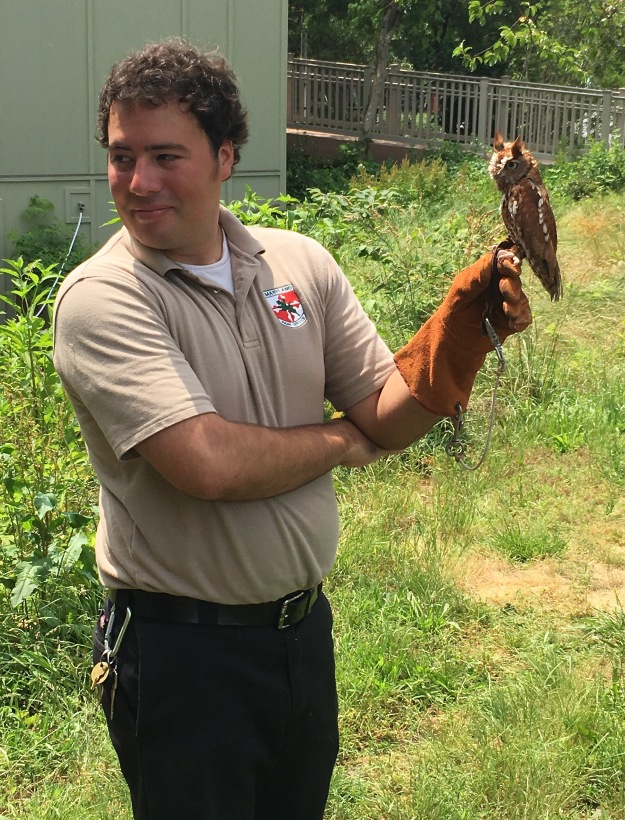
The Experience: As usual, my team and I were among the first to arrive. The forecast called for a hot, and humid day, and we intended to get going by 7:00 to get as far into the ride as possible before the heat of the day.  Rita had a little mechanical trouble, and needed some brake adjustments, but we got going at 7:15 while the majority of riders were still on their way to the start. Seven of us were out on the road – Myself, Ron, Rita, Stephanie, Eric, Carol and John – most of the usual suspects I ride with -though we had a lot of friends and acquaintences on the road that day. While I had a good ride, I was feeling the heat and managed to be consistent despite not feeling like I was at my best. The first section was just over 20 miles to Magruder’s Landing on the Patuxent. We set a comfortable pace, and I settled into the ride. John and Carol had gone ahead, but we met them at the first stop, and managed to get going again just as the area started to get a good crowd of riders coming in. The ride rolls, particularly on the Metric course, and the section between Magruder’s Landing and Eagle Harbor had some good climbs, but I rode them well and kept drinking – the secret to riding in the heat. Eagle Harbor is past the halfway point of the ride, but coming out involves a climb out above the river. The next stop was the Merkle Wildlife Sanctuary, 18 miles from Eagle Harbor. By this time Rita was concerned about her bike and the group splintered on the hills. John and Eric got to the front, and I was behind them, just in sight. Behind me were Ron and Stephanie, and Carol was grinding her way up the hill behind them. With about 5 miles to go until Merkle, Eric had ridden ahead, John had waited for Carol, and I found myself riding alone. I waited for Ron and Stephanie and the three of us rode to the rest stop together. We would all gather and leave Merkle together. As we rode in, I encountered the son of a friend from Arlington, VA. Rad was riding well, and had dropped his parents. He joined us for refreshments, but left to finish before us. By the time we got in, Eric had left, but we knew where he would be when we got back to the start. We had the chance to meet Merkle’s resident owl, and  pulled together to finish.  We ended up splitting into pairs on the climb out of Merkle – I found myself in front with Stephanie, Ron and Rita rode together, and John and Carol did the same. The finish was at a low point, so the final 3 miles were mostly downhill. We cruised to the finish and all gathered to celebrate in the shade. We’d earned our beer that day!

Selections from my mental iPod during the ride: “Not Only Numb” by The Gin Blossoms, “Letter to Elise” by The Cure, and “Ants Marching” by The Dave Matthews Band.

Stats: 63.61 Miles ridden, at a fairly strong and consistent pace despite the heat.

Mag_Landing

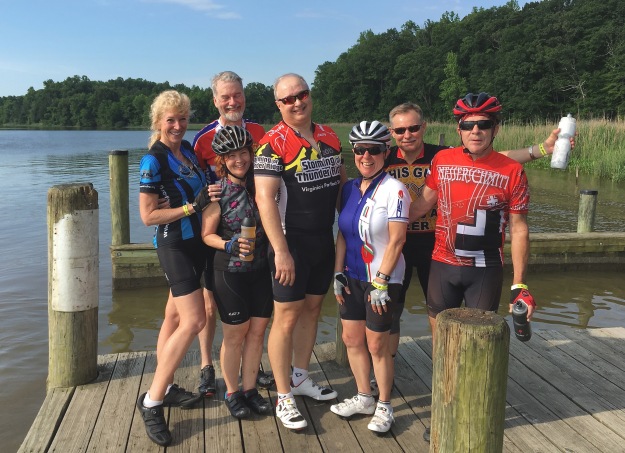
The crew on the dock at Magruder’s Landing – Stephanie, Eric, Rita, Myself, Carol, Ron and John.

Eagle Harbor

Beating the Heat at Eagle Harbor, just over halfway though the ride. Stephanie gets the photo credit!

Owl1

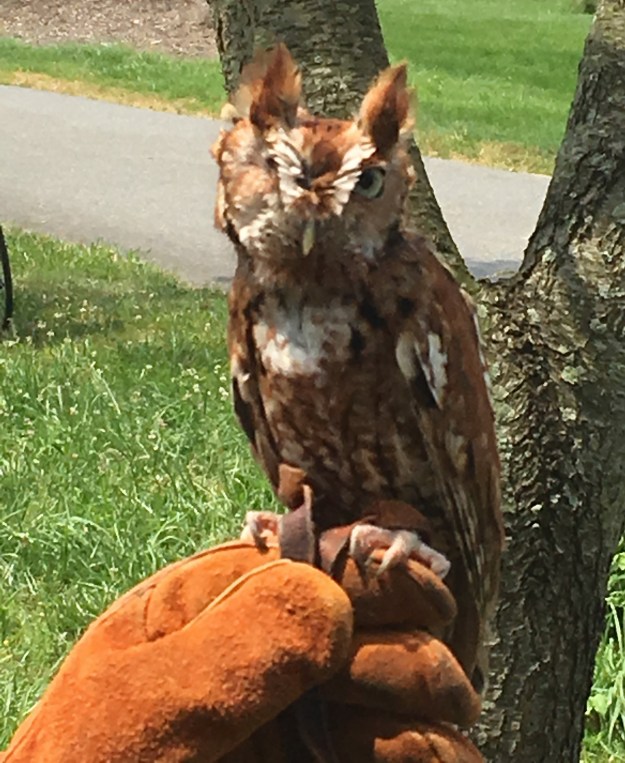
We met up with this Screech Owl at the Merkle Wildlife Sanctuary again this year. She didn’t seem to be bothered by all the attention she was getting from the bike riders.

Owl2

Despite her diminutive size, this owl is a full grown adult.

SMECO 75 – 2016

Today’s ride: The SMECO 75 is a rolling ride in Southern Maryland. It’s sponsored by the Southern Maryland Electric Company, thus the unusual name. It’s an “in-between” distance, not the typical Metric or English Century distance of 63 or 100 miles, but that in itself is a novelty. The roads are generally good; there are some climbs to deal with, but they’re not long or particularly steep, and the ride is very well supported.  While the ride tends to fall on hot days, since it’s held on the first weekend in June, SMECO doesn’t make you wait too long for water. There are plenty of stops. This ride gives away a lot of little gifts with your registration, including a drawstring bag and a stylish water bottle – not the kind you take on your bike, but the kind you’d see at the gym or keep at your desk at work. The ride also goes through Southern Maryland’s Amish community, so you might see the occasional horse and buggy on the roads.

The Experience: In keeping with 2016’s weather pattern, this ride held out the threat of rain. My friends and I decided to leave by 7:30 to reduce the chance of being rained on.  It was foggy and humid, but not warm at the start. Experience warned me to stay hydrated and hold on to some energy for the end of the ride. I was in a pensive mood, in contrast with the ebullient Eric, who finds delight in any gathering. We were joined by John, Carol, Tony, Ron and Denise T, who was riding her new Cervelo S-5 dream bike. We rode out into a lifting fog. While the temperature was comfortable, the roads were damp in areas that would normally be shaded, so we had to be careful when riding downhill. Conditions didn’t favor seeing every obstacle. One memorable feature of this ride is a short, steep climb just before the first rest stop. This year the ride route took the same hill from a different direction, which made it a longer, easier climb, though still a significant effort. For some, this might be a good feature, but part of me wanted to feel the strain, to breathe hard and work my way up that steep climb. As it was, we still had a climb, but the flavor was a little different. It didn’t detract from our enjoyment. As the ride went on, the weather never changed. It was cloudy and humid, but the rain didn’t arrive. With the exception of a bee sting on Carol’s shoulder, which was tended with care at the final rest stop, there were no challenges to us; the heat stayed manageable, and the ride was thoroughly enjoyable. 75 miles is an odd distance. Like a metric century, it doesn’t reach very far into your reserves. 100 miles is always a test, but 75 is more manageable if conditions are good.  Without the usual heat, this year the SMECO 75 seemed more tame. That suited me just fine!

Selections from my mental iPod during the ride: “My Ever Changing Moods” by The Style Council, “Soothe Me” by Sam & Dave, and “Stone Cold Sober” by Del Amitri.

Stats: 74.85 Miles ridden, well within the margin of error for my bicycle computer. I decided not to circle the parking lot just to make up the distance number. Some days close is just fine.

SMECO_Group

The rogues gallery for SMECO 2016 – Eric, Denise, Myself (hiding at the back) Carol, John, Tony and Ron at the first rest stop.

Tom_SMECO

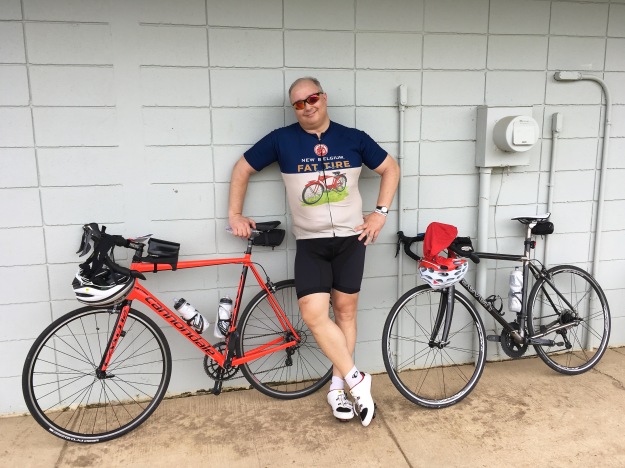
Holding up a wall at the third rest stop.

2016 Florida Safari

The ride(s): The Florida Safari is a week long series of rides in Northern Florida and Southern Georgia put on by the Florida Freewheelers bicycle club. There are 3 day and 6 day ride options. The first 3 days rides are from Live Oak Florida, and the last three days rides are based out of Cherry Lake Florida. The cost includes food and entertainment; and the food is very good. The courses are rolling but the climbs aren’t steep. There are a variety of distances offered each day, with two days offering full century courses. The courses were well marked and the rest stops were well placed and well stocked. The support was excellent. The Safari organizers are cyclists themselves, and they paid a great deal of attention to detail. It is a week long experience that riders tend to return for year after year.

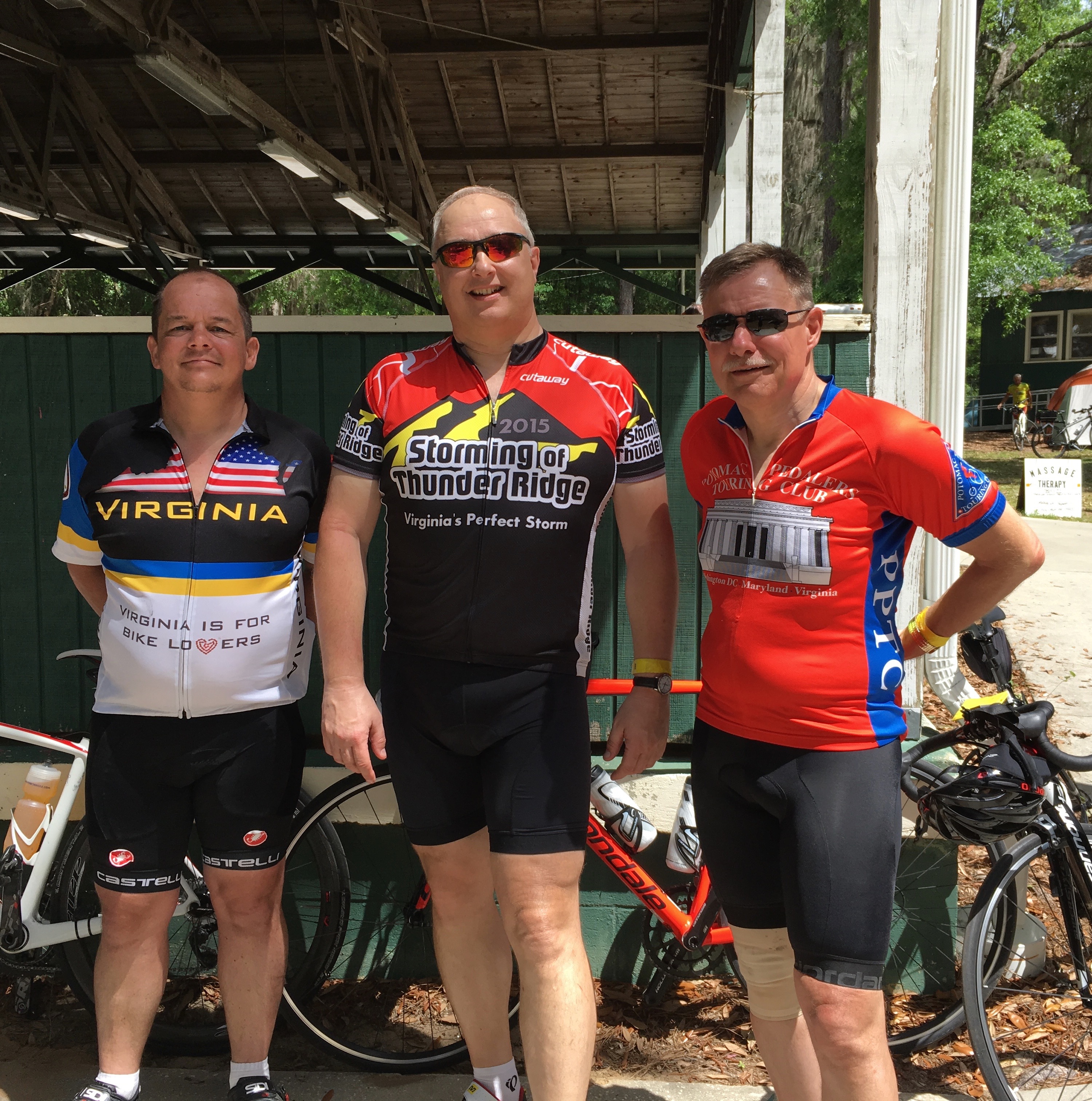
The Experience: I have heard about this event for many years, since my friend Ron has been riding it and talking about it – and this year I finally had a chance to see for myself what he was talking about. The Safari did not disappoint. I came to Florida with high hopes of experiencing all that was available to me, and had I spent more time on my bike, whether on the road or a trainer and less time in my office, I might have done so.  However, conditions and deadlines made that difficult, and I approached the Safari as training in itself.  I had hoped to ride a century or two, but in the end I rode a metric century, or it’s equivalent distance on average each day – which was enough to get me in much better condition by the time I headed north to Maryland again. All the while I was dealing with camping and meeting new people and trying new things. When Ron and I arrived in Live Oak, we connected with another friend, John Summer from Fredericksburg Virginia.  I’d met John last year when he came up to Maryland for a training ride in September – he was planning to ride the Seagull Century, which was washed out by Hurricane Joachim.  He is a good natured man and a talented rider, and the three of us rode together for the most part. Since John and Ron were veterans they had done something that I had failed to do – prepare. Still, as camp mates we all got along. The normal good natured banter that is typical of these occasions applied, and in the spirit of the occasion, we cooperated in camp and on the roads.  It was a good arrangement. While my companions both got maximum miles from their Safari, I did not. This didn’t bother me too much – I was satisfied with the miles and progress I made.  When I do this again, I will be much better prepared, and perhaps then I’ll go for maximum miles, if conditions allow. The important part was the experience, which included some triumph and misfortune for me, but we had fun, we had rides, and we had beer.  All the ingredients for a memorable event were there. Setting aside the drive to and from home, the Safari was a 6 day event, so I’ll present a few notes by day:

Day 1 – A mass start from the fairgrounds for a 67 mile ride to kick off the Safari. We were near the front and set off quickly.  Some riders left early, so there were a lot of riders on the course, but we were ready to ride and we did so, at a good pace. I enjoyed myself but in retrospect it was foolish to put so much energy into riding on the first day of a 6 day event. I remember rolling back to Live Oak after a day in the hills at a virtual sprint. It was great fun, but my new bicycle didn’t quite have the fit dialed in. After we finished I was more tired than I should have been, and worse – I had a sore left knee. All that after having had little sleep after camping for the first time in years. No problem. We had beer back at camp!

Day 2 – I set out with my left knee complaining quite loudly, and the rest of my body complaining somewhat less. I would pay for that early speed on day 1. I wanted to ride the century that day – but that would not have been wise. At the first rest stop I went to the Safari mechanic at John and Ron’s suggestion – a true bicycle whisperer named Diane, and talked about my aching knee. She checked my position and adjusted my saddle, and I felt better immediately! My knee was still tender, and the conditions were challenging, including headwinds over 20 MPH that day – so after suffering through 67 miles, my body surrendered. I caught a lift back to camp. No problem. We had beer. There was a band playing and good food, too. My body began to adjust to the new normal.  I found lying on the ground no barrier to getting 5 or 6 hours of sleep.

Day 3 – Transition to Cherry Lake.  Breakfast. Break camp. 58 miles to the lake. My legs feel fatigued. I let my camp mates go ahead after the second rest stop, and rode in alone.  A funny thing happened – I didn’t really slow down.  I just needed more rest. Riding alone for half the ride was good. I didn’t feel like I was holding the others back.  Cherry Lake turned out to be beautiful. I found that I could ignore my aching muscles and relax with the guys.

Day 4 – A century day, but I decided to go ride the metric+  and see who I could find to ride with. I ended up riding with a group from the Florida Freewheelers.  I had a good time with them. They were also going to go for beer, so I was invited to their campsite that evening to swap stories and sip.  I hooked up John and Ron with the group and we were once again celebrating a day on the bike with beer.

Day 5 – A metric + ride into Georgia. I am back. Despite my aching legs, I can roll with my friends, and it feels good. The scenery is gorgeous, and the riding feels good, and the banter is familiar. I’m riding the way I want to. Bliss. This is the last night at Cherry Lake.  The beer is provided, along with a barbecue dinner that is wonderful. Ron uses his experience as a DJ and radio expert to win a trivia challenge from our entertainer – and gets a T-Shirt for it. We feel spoiled. Safari feeds you well!

Day 6 – Back to Live Oak, our cars, and the end of the Safari. I am feeling good again. At the first rest stop, I am greeted by a friendly Border Collie. I love dogs.  As I’m getting ready to ride again, I get a bump on my calf. I’ve been head butted by that little herding dog.  Being herded by a Border Collie is a sign that I have to get moving and finish my Safari. The ride back includes the only busy road we took all week – and despite my getting a little too close for my comfort to a logging truck as I came off the front after pulling into the wind, the ride goes well. We arrive at the fairgrounds, pack up, shower, say our goodbyes, grab a complimentary slice of pizza, thank our hosts, and get on the road back to Maryland.

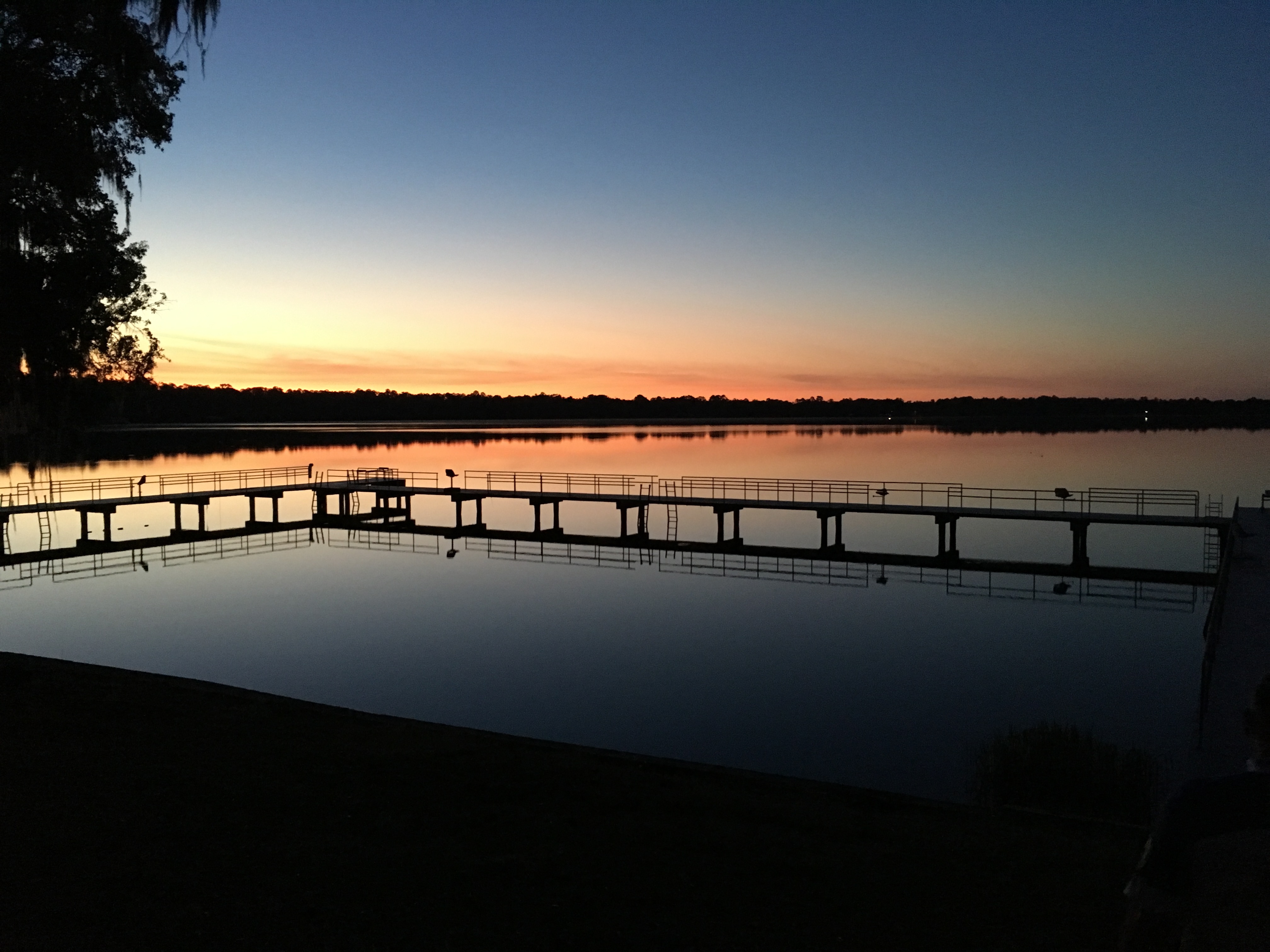
I’ll remember a lot – camping, sunrise and sunset over Cherry Lake, coffee at 5:30 in the morning before jumping up into the queue for breakfast at 6, the excellent meals, the courses that challenged the notion that Florida is all flatland, all the great people to talk to, the roadsides full of wild flowers, owls calling at night, train whistles at night from the crossing in Live Oak, landscapes a painter would love, and good company along the way.

Selections from my mental iPod during the ride: Far too many songs, with far too many musical genres to mention. Needless to say, music traveled with me wherever I rode.

Statistics: 372 Miles in total. Not bad for an out of shape man getting short sleep. They are wonderful base miles for rides later in the spring!

FS_01

In camp at Live Oak, on arrival.

FS_02

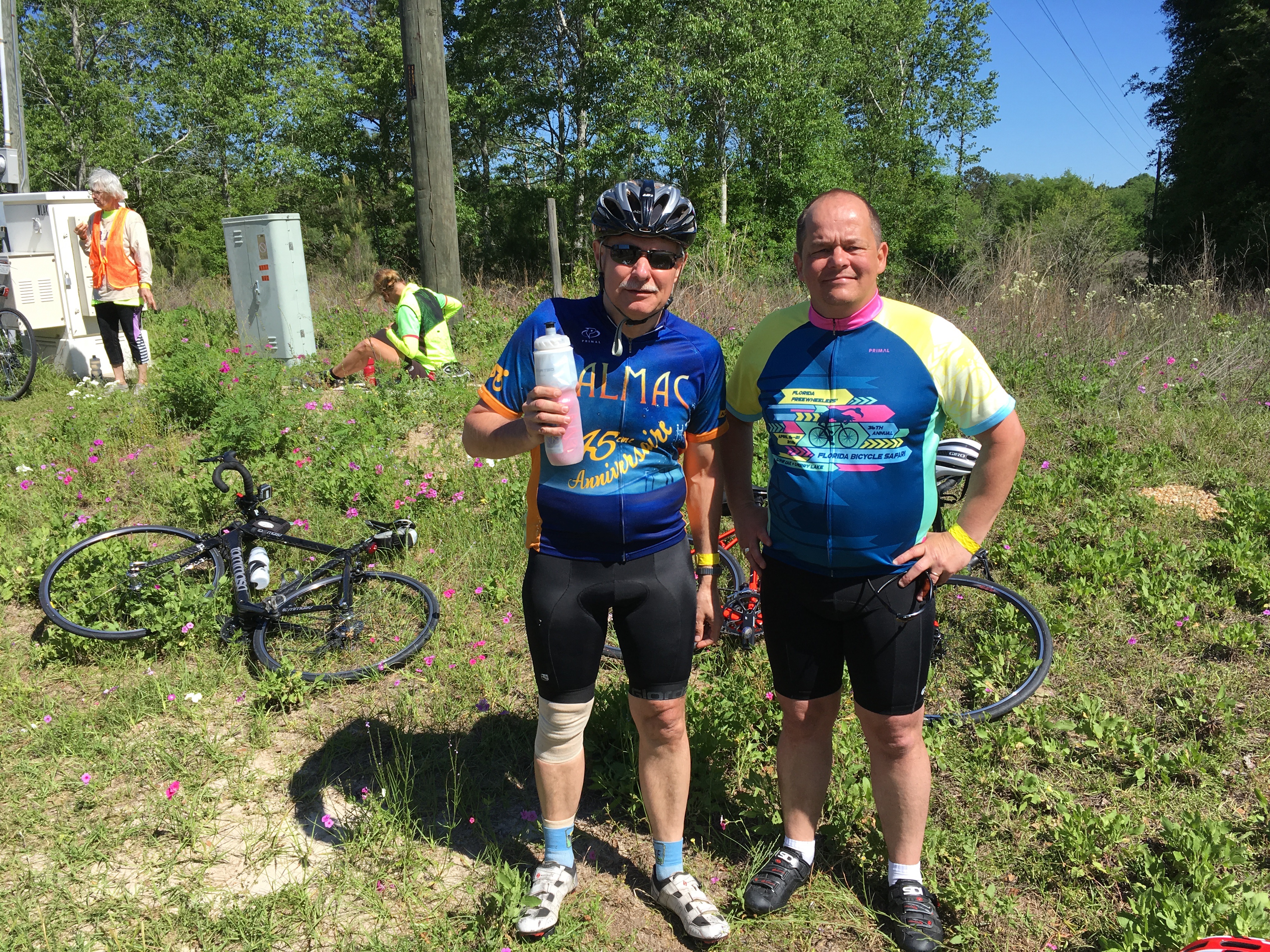
Day 1. Suanee Bicycle Association rest stop.

FS_03

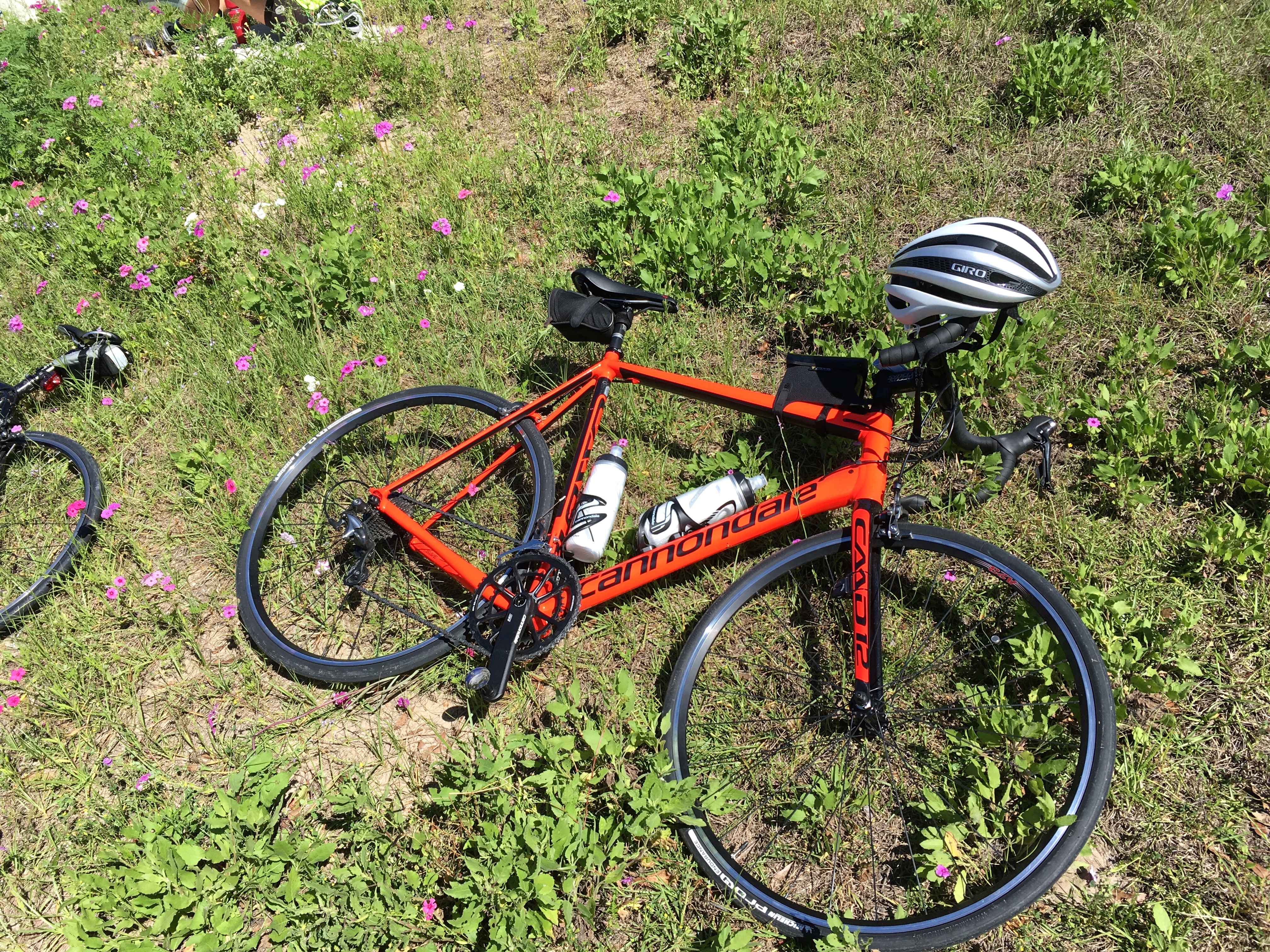
Day 3 – My bike among the roadside flora.

FS_04

Day 3 – Ron and John, headed for Cherry Lake.

FS_05

Sunrise over Cherry Lake.

FS_06

Day 5 – Post Ride!

FS_07

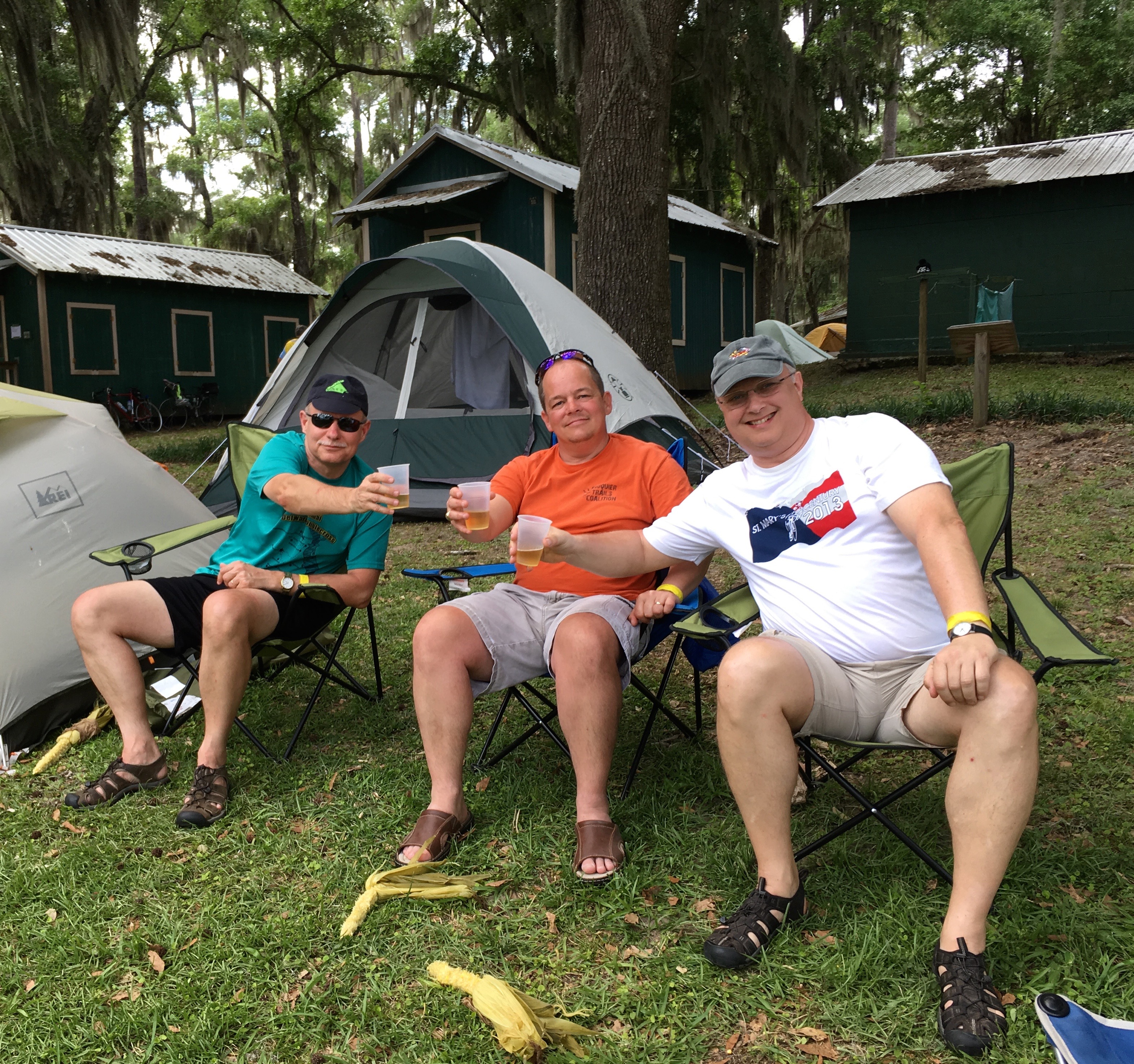
Day 5 – Celebrating.  Note the corncobs – riders do not live on beer alone…


Cycling through a warm autumn, and dreaming of spring.

It’s mid December, and yesterday I got in another 50+ mile ride. It’s not unusual to get in a December ride, but having the weather to allow longer rides is unusual. Of course whenever the high temperature goes below 40 degrees, it’s very hard to ride any serious distances, and since it’s getting dark and cold about the time I leave work, getting weekday rides in is also very hard. Yet this year I’ve managed to get through November and into December while riding good distances on the weekends with my cycling friends. I see no benefit to climate change, but while the daytime high temperature on Saturday hovered around 70 degrees, it was too good a day to waste indoors.

Every December, my friend Ron wraps himself up, gets on the bike, and cycles over 25 miles from his home to Mount Vernon, where he picks up the latest christmas tree ornament from George Washington’s estate. The round trip is over 50 miles, and usually cold. Not so today, so in the holiday spirit, 5 of us joined him on the ride. Eric, Rita, Tony, Matt and I made it an adventure, including stops for coffee in Old Town Alexandria, and Lunch at Mr. Smith’s in Georgetown under the Whitehurst Freeway by the Potomac waterfront.

Ornament

This was among the best of times, because we had the perfect combination of social and unhurried riding, perfect weather, and a goal at our destination.  Every bike ride is different. Some are fast and competitive, some are challenging, and some are explorations, but this was simply what I call a ride for the soul. No pressure, nobody gets dropped. Everyone just enjoys the company and rides for the pure enjoyment of moving and sharing the day with others. This autumn has been full of such rides. Fall riding is usually dominated by the scenery and complicated by the chill, but they also tend to have the unhurried flavor of riding for the sake of enjoyment.  Usually in the fall you’re in fairly good condition coming out of a busy summer and having made the most of your event rides in September and early October.  Some riders hang up their bikes at this time of year, but if you can get the right clothes and some friends to join you, these can be memorable times to ride.

One of the reasons I’m enjoying this time stems from an impulse buy I made back in September. It’s a Cannondale CAAD 12 bicycle.  The color was unexpectedly bright, and since it’s a day glow color as if it was radioactive, it named itself – “The Nuke”.  This is an aluminum framed bicycle, but it weighs the same or perhaps slightly less than the red Orbea Onix bicycle you’ll see pictured in many of my past posts. I’d been enjoying the Orbea since 2010, and when I ordered the CAAD 12 it was just to get a bicycle that was different in fit and feel, which would also allow me to customize the Orbea to be geared for hill climbing. While aluminum bicycles are often taken to be hard riding frames, this one is surprisingly comfortable.  Experimentation with Carbon Fiber frames has allowed designers to make custom tube shapes that actually make an aluminum bicycle much more comfortable, and given that I ride the Cannondale with a slightly wider tire (23 mm to 25 mm) at a slightly lower pressure than before, it does tend to smooth out any differences I might have felt between the frame types.  The CAAD 12 has a mid range double crankset (52/36) Shimano Ultegra components, including brakes, and internal cable routing. All for much less than a similar carbon fiber framed bike.  A carbon bike at the price point I bought the CAAD 12 at would have lesser components, and I think that it’s an incredible value for the price.  Now that I have several hundred miles on it in a variety of conditions including steep climbs, I can report that the bike is a worthy competitor for a carbon bike at that price point. It’s quick, responsive and smooth, and I think it is great for an enthusiast as well as a racer. In any event, I’m really enjoying the bike.

CAAD12

Even though it’s unusually warm as I write this, it’s still December. That means it’s time to look ahead to events in the spring.  This is the best time to sign up for spring events, when the price is lowest. So far I’ve signed up for my usual first century of the year, the 6 Pillars Century, and a challenge ride – Storming of Thunder Ridge.  Usually, these are cold days and signing up for rides helps you dream of spring – but on a day that feels like spring, they’re a different kind of inspiration.  While I’m riding on these weekends, I’m not only thinking ahead, I’m enjoying my rides as I do.  It doesn’t get any better.  It won’t stay warm for long, but while I’m riding and signing up for spring rides, I feel a lot more connected to the bike than I normally do this time of year. I’m hoping for a short winter!