Many years ago, on a cool morning in late March, I was flying a Firefly fighter that I’d built the night before on kite hill in Magnuson Park in Seattle. A man approached me to ask if he could film me flying my kite. While he said there was no wind, there was actually a very light breeze, but fighter kites fly well in light winds that other kites may not be able to launch in. I thought I’d share that video with you.
The Simple Joy of the Fighter Kite
For many years now, I’ve been building and flying fighter kites. To me, they are beautiful in their simplicity and their motion. They can be a thrill when flown on a short line or in competition. They can be a kind of mobile mandala or meditation target when I fly alone. They connect me to the sky.
As kites go, fighter kites don’t get a lot of notice. They don’t make a big display and they aren’t easy to capture in photos or film because of their quick, darting flight. They do not pull hard like many multi-line stunt kites. They maneuver on a single line through line tension, and a flyer needs to know when to pull the line and when to give the kite slack line. It’s much like flying a leaf on a thread. They’re not complicated. A simple diamond shape with a spine and a bowed spar from wingtip to wingtip is the most common form, though there are other variations. They usually aren’t much more than two feet across, and they don’t have much surface area for decoration. They can be temperamental, and getting one to be consistent takes some patience and care.
Once you get a fighter kite in the air, you are rewarded with a lively little dragster that responds quickly to your inputs, moves with unmatched speed, and changes direction in an instant. It is designed to be unstable on a slack line, and stable on a taught line – the secret to the kite is it’s flexibility. A fighter kite is the high performance race car of tethered flight. When you fly one on a short line, it is quick and reacts in an instant, when you fly on a longer line a fighter takes longer to react and becomes more tame – you can fly one in any way that fits your mood. A fighter’s motion can be hypnotic. The speed and adaptability of a fighter kite is part of it’s charm. While a stunt kite is always the same distance from the flyer due to fixed line lengths, a fighter’s single line gives the flyer options. You can fly on any line length you choose. Once you master the skill of flying one, that simple kite can be a source of great joy.
I found fighter kites through a combination of curiosity and luck. It started with a kite catalog that interested me in flying kites. A fighter kite peaked my interest, but fighter kites aren’t commonly mass produced for sale in the west. In India and southeast asia, where they originated, the kites are made of bamboo and tissue paper, and flown on cutting line. The line is coated with rice paste and powdered glass, and when two lines come in contact, one is cut. Therefore, the traditional fighter kite is commonly a disposable object. There aren’t many that are mass produced from fabrics or more durable materials. I found books about building them, and that had appeal to me, but I really began to understand them when I met a group that had just formed to build and fly them. Since that time, I’ve been a fighter kite specialist, and they’ve been a source of entertainment and joy for many years.
I have flown fighter kites in competitions, I have flown fighters on cutting line and felt the joy of cutting and being cut, I have designed and built kites to fly indoors (you have to back up to keep the kite flying) and I have won prizes at kite festivals for my kites. That simple kite form has been very kind to me over the years. I enjoy designing and building fighters. I’ve always been proud to fly my own creations. I build my kites out of Mylar or Clearphane (a plastic film that is semi-opaque, a colored cellophane.) and I also use a material called Orcon, which is a lightweight, flexible ripstop plastic material that was once used as a vapor barrier in aircraft. I use graphite rods for my bows (the flexible spar from wingtip to wingtip) and bamboo for my kite spines. I build them with three point adjustable bridles so I can adjust the balance of the kite and adapt to wind conditions. I’ve been pleased with the results over the years. I don’t rush my kite building, but I can build one quickly in a few hours. I have experimented with sail shapes and materials, and I have my favorites, but in the end, they all produce the same result, a kite of speed, simplicity and pure joy to fly.
The photos below are of a swallow-tailed fighter I call a Firefly. This example is made of mylar, using a bamboo spine, graphite rods for the bow and the tail battens, contact cement, packing tape to reinforce the places where the sail is under strain, and loose-leaf page reinforcements at the place where the bridle lines go through the sail to attach to the bow near the front of the kite. This example isn’t bridled yet, but in the sky it will be kinetic art.
The front of the kite. Red mylar is very visible. The back side. Fighters are designed to flex.
Patuxent Rural Legacy Ride
Today’s ride: The Patuxent Rural Legacy Ride is a Metric Century starting in Croom Maryland. This is a rolling course that parallels the Patuxent River. The rest stops are scenic, most of them with views of the river, and the roads don’t have much traffic. The ride is very well supported and the course is clearly marked. It ends with a picnic at the ride start.
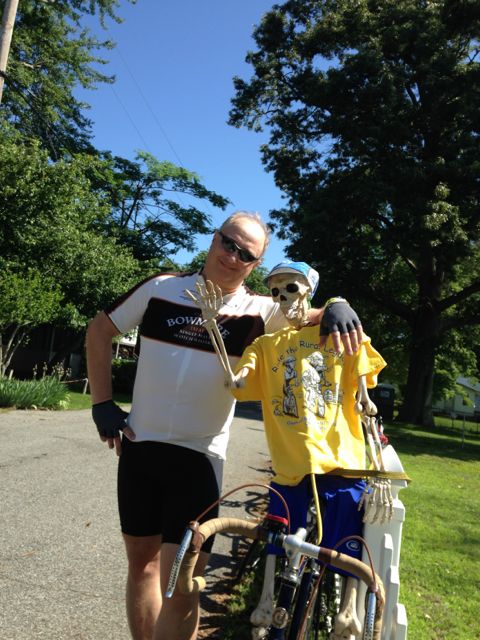
The Experience: Two of our group needed to leave early to attend a wedding, so we all got to the ride start in time to set out at 7 am. The weather was cool, clear and still when we set out. I’m of the opinion that you should dress for mile 5, not the start. Once you’re warmed up you don’t need the extra clothing, and I don’t like to carry things I don’t need. We rode easily to the first rest stop, with the group staying together. This time it was Myself, John Koehnlein, Carol Linden, Ron Tripp, Eric Sanne and Tony Lehr. A rider we knew named David was with us as well. I love riding in rolling terrain. The constant changes mean you must react to quick climbs and descents. They provide a variety that makes a ride seem more interesting. As we began the second leg, I lifted the pace a little. We built up some momentum, and arrived at the second rest stop, where we posed with a friend – a skeleton wired to a bike. This was a popular activity with the riders at the stop! Before we left, we were caught by Carmen Legato and another rider he’d been riding with, Christy. Our growing group rolled out and lifted the pace again, passing other riders and moving along smoothly. The last rest stop was at the Merkle Wildlife Sanctuary, which in previous years had been the start/end point. I saw more friends on the way out. We finished strong in the final 8 miles, one of the rare rides where we built the pace from start to finish. By the end, the music I was thinking of was working with our pace – particularly the last selection below! Eric, Ron and Tony all rode well. On a ride where the pressure kept building, they all held on and handled the pace with ease.
After the ride, we got together for beer and laughter. We also got lunch courtesy of the Oxon Hill Bicycle Club, who sponsored the ride. My friends Judy and Dave and their son Rad joined us for a while, and fellow PPTC member Deb Reynolds visited us too. It’s good to take some time to be social and enjoy the company of friends after we’ve shared a ride.
Selections from my mental iPod during the ride: “E=MC2” by Big Audio Dynamite, “Circus” by Spirit of the West, and “She Sells Sanctuary” by the Cult.
Stats: 64.02 Miles ridden. When you find another gear, both for power when you climb and speed on the flat, whenever you want one, you know it’s a good day!
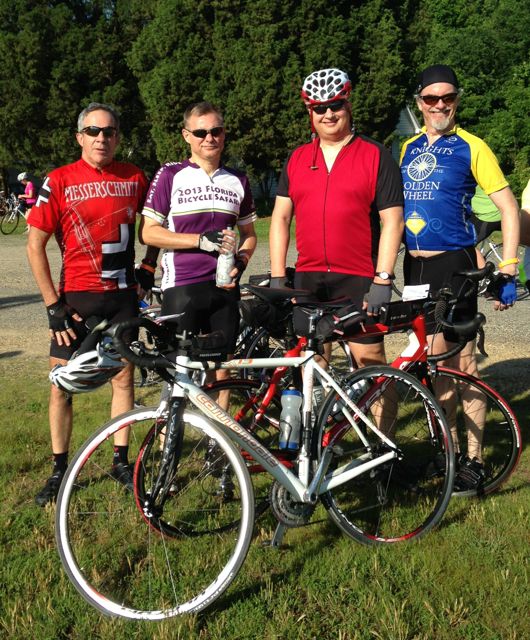
With John at the ride start. With a friend at the second rest stop!
Train to Chesapeake
Today’s ride: Train to Chesapeake is a Potomac Pedalers Touring Club ride that starts from Harwood Md (South of Annapolis on Route 2) and heads to North Beach on the West side of the Chesapeake Bay, and returns. There are usually 2 routes, a 47 mile circuit and a 61 Mile Circuit, and they both go through rolling terrain. This ride is usually scheduled for both Memorial Day and Labor Day, and it is very popular with the local bike clubs. This ride gives you a challenge without being too hard on less experienced riders.
The Experience: This was a ride to arrive early for, in order to socialize, and I talked to a lot of riders whom I don’t get to talk to often. It was very enjoyable to catch up. The course was changed slightly this time due to a road closure, which dropped a little distance from the long ride, but the weather was cool and clear, and while we had some wind to contend with, for most of the ride it didn’t seem to bother us. I rode out with Eric Sanne and Tony Lehr, the former an old friend who is enthusiastic but doesn’t remember routes well, and the latter a rider we met the week before at CASA River who didn’t know the area. What that meant was that I would be the shepherd and GPS for us, keeping us on course while finding and holding a pace that would satisfy us all. Like most rides with a lot of riders, it pays to stay focused at the start of the ride. This ride was no exception. When everyone is fresh, you’ll see some riders who can’t settle down and pace themselves because they’re excited, charging up hills, boxing in other riders, or suddenly slowing down when they look at cue sheets. I knew the area, and I was looking for problems, so we found a good pace and stayed safe. Eventually the three of us found ourselves riding alone with Bob Sheldon, an old friend and experienced rider whom we seldom have the pleasure of riding with, tacked on to the back of our line. We managed to get to the first rest stop without incident, and by then (just over 20 miles) the ride had strung out a little and we settled in comfortably. We were humming along like a well oiled machine through the rolling terrain west of the beach, and we were all in good shape and good spirits as we got to the second rest stop at the beach at the 40 mile mark. We pulled out a little later, with the day beginning to heat up, prepared to climb from sea level back up to the start with water bottles topped off and Carol Linden joining us. However, before we got away from the beach Eric had a flat tire. This is a common occurrence, and we waited with him while he fixed the flat. Carol, sensible of the heat and climbs ahead, and knowing we were riding well, went ahead expecting us to catch her up. When we got back on the road we reached the first climb in good spirits, and took that long climb at a good clip, with Eric claiming King of the Mountain points (the imaginary kind) at the top. We caught Carol several miles up the road, but Carol is a strong steady rider who rolls up the miles on these rides very well. We finished strong without any other incidents, feeling the satisfaction of a strong ride on a beautiful day. We earned our post-ride brew!
Selections from my mental iPod during the ride: “Rescue Me” by The Alarm, “Hold On, I’m Coming” by Sam & Dave, and “Trip Through Your Wires” by U2.
Stats: 59.32 Miles ridden. The kind of ride that “consistent” describes beautifully, on the kind of day that was made for bicycling.
At North Beach: Carol and Eric, Carol, Myself and Tony.
CASA River Century 2014
Today’s ride: The CASA River Century in Shepherdstown WV. This is an excellent early season ride. Held in mid-May, while the weather is cool, this is a rolling ride that has excellent scenery. West Virginia is hilly, but the hills on this ride are short climbs followed by refreshing descents. Often you’ll get much of a climb done through momentum from the previous descent. Riders can see wildlife, mountains, river views and farms. The ride is well supported. There are two loops to the century, so riders can drop off jackets or other items as the day warms up, and there is a variety of good food served to the riders at the middle and end of the ride.
The Experience: This year there was a torrential rainstorm the day before the ride which caused some local flooding. Some of the roads on the course were closed. The organizers had to map a new route for 50 miles the night before, and then asked the century riders to make two circuits. The organizers did a good job under tough conditions to hold the ride. I had been sick the day before, and I was recovering. So I knew that with my body weakened, the ride would be tough. I could have reasonably ridden a shorter ride, stopping at 50 miles, or simply not gone, but I chose to harden up and ride the entire thing. Was this wise? No. There were consequences to pushing though the pain and riding anyway. Yet I chose to tough it out and complete my 100 miles. Serious cyclists talk about suffering in offhand ways. We treat suffering as something we have to do, the price of riding. We learn to recognize when other riders are suffering. In a race, when you see suffering on someone else’s face, you attack. When you’re riding for fun, you support each other. At the end of the ride, I needed my friends around me. It was a windy day, and chilly when we weren’t in the sun. The scenery was amazing. The long views from the top of the ridges were outstanding. I ended up riding normally for about 60 miles. Then things started getting tough. At around 85 miles my legs ran out of juice and I started cramping up. Was I drinking enough? Yes. Was I eating enough? I thought so. Did any of that matter to me? No. I was in pain, but I just kept going. Assists go to Eric Sanne, John Koehnlein and Tom Roman for staying with me and seeing that I was safe. Thanks, guys! I feel good about riding through the pain, but it’s an experience I don’t want to repeat very often. I know I’ll have to suffer again though. We all have rides where we’re suffering more than usual and there is nothing we can do but keep going. The last 10 miles were driven by the promise of a beer at the end, and the shelled pistachio nuts that I brought to share. This was a very unusual set of circumstances for this ride, and for me. In any other year, this is a ride to look forward to!
Selections from my mental iPod during the ride: “No Myth” by Michael Penn, “Someday, Someway” by Marshall Crenshaw and “Wild Night” by Van Morrison.
Stats: 100.22 Miles ridden. This was a difficult ride for me, but a satisfying result – 100 miles while I was not at my best.
6 Pillars Century 2014
Today’s ride: The 6 Pillars Century in Cambridge MD. This is one of my favorite rides, because of the landscape we ride through. This ride goes through the Blackwater Wildlife Refuge, and there are views of the Chesapeake Bay, not to mention all kinds of waterfowl and other birds like Ospreys, Herons and Red Winged Blackbirds. The landscape is tidal marsh and some farmland. The ride is flat as a table top, with the only thing that approaches the definition of “hill” being bridges. With that said, wind can be a big factor on this ride. Flat rides don’t offer you much variation in terms of position on the bike, so fatigue of feet, seat and hands can be a problem, but this ride has such spectacular scenery that those things really don’t matter. This ride is a feast for the eyes. It is held on the first weekend in May, and for me it’s usually the first important local event of the year.
The Experience: It was a perfect cycling day, cool but not cold, the wind wasn’t too bad except for the area of Hooper’s Island (where you can expect it) and the end of the day when it picked up a little. We started out well, perhaps even a little faster than we might have liked, but we were remarkably consistent all day. We had some riders who were rock steady and strong all day – Tom Roman, Matt Birnbaum, and Ron Tripp leap to mind. Eric Sanne and Carmen Legato held on despite worries about their preparation, and John Koehnlein was ticking the pedals over in a slow rhythm that was hypnotic. Carol Linden as in and out with us between rest stops, and the team of Bill Harback and Denise Teeling were driving the early pace like heroes. Most of us were consistently riding about 18-20 mph all day in a long line. The riders around us were great. We were humming along passing riders, and we would warn them we were coming, and thank them as we passed. I found myself occasionally saying “Thank you, thank you very much” in my best Elvis voice as I rode past, just to make it a little more surreal. The last 20 miles were fast – at a time in the ride when we usually slow down, we actually got faster. Holding on to the pace was tough. Tom Roman had a huge hero pull for our line in that section of the ride, and after he set the tone for us, we held together in unison like a single living creature. The after ride celebration was full of laughs, with music courtesy of Matt Birnbaum, beer supplied by just about all of us, and smiles until our faces were in danger of breaking. We invited a couple of riders who parked nearby to join us, and they turned out to be from the Reston Bike Club. They were glad to share beer and stories with us. Happy is contagious.
Selections from my mental iPod during the ride: “Johnny B Goode” by Chuck Berry, “Eastern Bloc” by Thomas Dolby and “Poets” by the Tragically Hip.
Stats: 100.27 Miles ridden, plus a little extra riding to and from the cars. A strong ride from start to finish. The kind of feeling you want to bottle and save to use over and over!